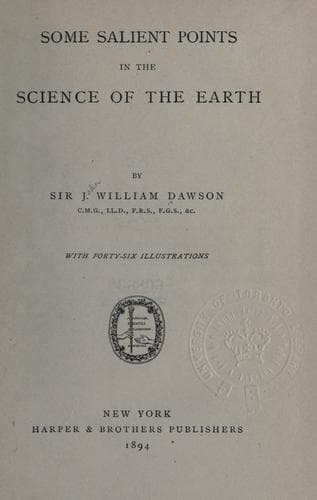
Some Salient Points in the Science of the EarthDawson, John William, Sir
Science
Some Salient Points in the Science of the Earth
Dawson, John William, Sir
Geology; Paleontology
Other oceanic islands present great varieties of conditions, but
leading to similar conclusions. Some, as the Bermudas, seem to have
been settled in very modern times with animals and plants nearly all
identical with those of neighbouring countries, though even here
it would appear that there are some indigenous species which would
indicate a greater age or more extended lands, now submerged.[186]
Others, like St. Helena, are occupied apparently with old settlers,
which may have come to them in early Tertiary, or even in Secondary
periods, which have long since become extinct on the continents, and
whose nearest analogues are now widely scattered over the world.
Islands are therefore places of survival of old species--special
preserves for forms of life lost to the continents. One of the most
curious of these is Celebes, which seems to be a surviving fragment
of Miocene Asia, which, though so near to that continent, has been
sufficiently isolated to preserve its old population during all
the vast lapse of time between the middle Tertiary and the present
period. This is a fact which gives to the oceanic islands the greatest
geological interest, and induces us to look into their actual fauna and
flora for the representatives of species known on the mainland only as
fossils. It is thus that we look to the marsupials of Australia as the
nearest analogues of those of the Jurassic of Europe, and that we find
in the strange Barramunda (_ceratodus_) of its rivers the only survivor
of a group of fishes once widely distributed, but which has long since
perished elsewhere.
[186] Heilprin mentions eleven marine mollusks supposed to be peculiar
to the islands, and eight species of land shells, as well as a few
Crustaceans hitherto found only in the Pacific. The comparisons are,
however, admitted to be incomplete.
Perhaps one of the most interesting examples of this is furnished by
the Galapagos Islands, an example the more remarkable that no one who
has read in Darwin's fascinating "Journal" the description of these
islands, can have failed to perceive that the peculiarities of this
strange Archipelago must have been prominent among the facts which
first planted in his mind the germ of that theory of the origin of
species which has since grown to such gigantic dimensions. It is
curious also to reflect that had the bearing of geological history on
the facts of distribution been as well known forty years ago as it is
now, the reasoning of the great naturalist on this and similar cases
might have taken an entirely different direction.
Public-domain text, read in full here on John Shaqi.
Reviews
Reviews
No reviews yet
Be the first to share your thoughts on this work.
Elsewhere in the archive
Join the Discussion
Join the discussion
Sign in to leave a comment or review.
Sign InorCreate an account