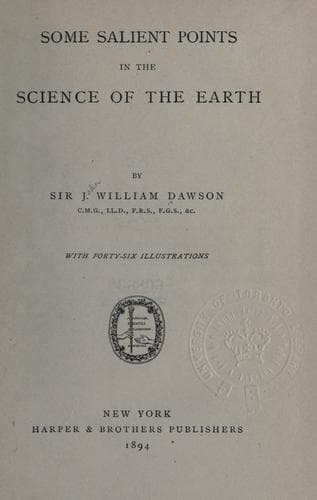
Some Salient Points in the Science of the EarthDawson, John William, Sir
Science
Some Salient Points in the Science of the Earth
Dawson, John William, Sir
Geology; Paleontology
from a cooler climate, and have not been able to don a tropical garb;
or perhaps they belong to a far-back age, when the vegetable kingdom
also was less rich in colouring than it is at present, and the birds
were in harmony with it. This, indeed, seems still to be the character
of the Galapagos plants, which Darwin says have "a wretched, weedy
appearance," without gay flowers, though later visitors have expressed
a more favourable opinion.
These plants are in themselves very remarkable, for they are largely
peculiar species, and are in many cases confined to particular islands,
having apparently been unable to cross from one island to another,
though in some way able to reach the group. The explanation is that
they resemble North American plants, and came to the Galapagos at a
time when a wide strait separated North and South America, allowing
the equatorial current to pass through, and drift plants to the
Galapagos, where they have been imprisoned ever since. This was
probably in Miocene times, and when we know more of the Miocene flora
of the southern part of North America we may hope to recover some of
the ancestors of the Galapagos plants. In the meantime their probable
origin and antiquity, as stated by Wallace, render unnecessary any
hypothesis of modification.
Before leaving this subject, it is proper to observe that on the
continents themselves there are many remarkable cases of isolation of
species, which help us better to understand the conditions of insular
areas. The "variable hare" of the Scottish highlands, and of the
extreme north of Europe, appears again in the Alps, the Pyrenees, and
the Caucasus, being in these mountains separated by a thousand miles
of apparently impassable country from its northern haunts. It no doubt
extended itself over the intervening plains at a time when Europe was
colder than at present. Another curious case is that of the marsh-tit
of Europe. This little bird is found throughout south-western Europe.
It reappears in China, but is not known anywhere between. In Siberia
and northern Europe there is, however, a species or distinct race which
connects these isolated patches. In this case, if the Siberian species
is truly distinct, we have a remarkable case of isolation and of the
permanence of identical characters for a long time; for in that case
this bird must be a survivor of the Pliocene or Miocene time. On the
other hand, if, as is perhaps more likely, the marsh-tit is only a
local variety of the Siberian species, we have an illustration of the
local recurrence of this form when the conditions are favourable, even
though separated by a great space and long time.
Public-domain text, read in full here on John Shaqi.
Reviews
Reviews
No reviews yet
Be the first to share your thoughts on this work.
Elsewhere in the archive
Join the Discussion
Join the discussion
Sign in to leave a comment or review.
Sign InorCreate an account