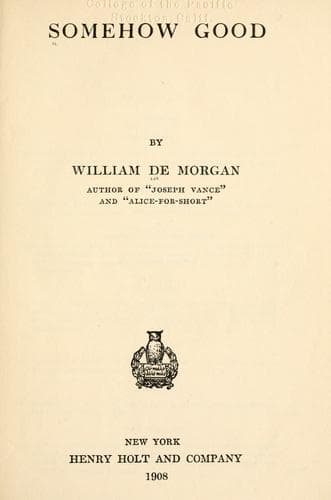
Amnesiacs -- Fiction; England -- Fiction; Mothers and daughters -- Fiction
She would have liked companionship inside the cloud, for all that. It
was a cruel disappointment to find, when she came to reflect on it,
that she could not carry out a first intention of taking Colonel Lund
into her confidence about the Baron, and the undoubted insight he had
given into some portion of Fenwick's previous life. Obviously it would
have involved telling her husband's whole story. Her belief that he was
Harrisson involved her knowledge that he was not Fenwick. The Major
would have said at once: "Why not tell him all this Baron told you, and
see if it wouldn't bring all his life back to him?" And then she would
have to tell the Major who he really was, to show him the need of
keeping silence about the story. No, no! Danger lay that way. Too much
finessing would be wanted; too many reserves.
So she bore her secret knowledge alone, for their sakes feeling all
the while like the scapegoat in the wilderness. But it was a happy
wilderness for her, as time proved. Her husband's temper and
disposition were well described by Sally, when she told Dr. Vereker in
confidence one day that when he boiled he blew the lid off, but that
he was a practical lamb, and was wax in her mother's hands. A good fizz
did good, whatever people said. And the doctor agreed cordially. For
he had a mother whose temper was notoriously sweetness itself, but was
manipulated by its owner with a dexterity that secured all the effects
of discomfort to its beneficiaries, without compromising her own claims
to canonization.
Fenwick's temper--this expression always means want of temper, or
absence of temper--was of the opposite sort. It occasioned no
inconvenience to any one, and every one detected and classed it after
knowing him for twenty-four hours. The married couple had not existed
for three months in that form before this trivial individuality was
defined by Ann and Cook as "only master." Sally became so callous after
a slight passing alarm at one or two explosions that she would, for
instance, address her stepfather, after hearing his volleys at
some offender in the distance, with, "Who did I hear you calling a
confounded idiot, Jeremiah?" To which he would reply, softening into
a genial smile: "Lost my temper, I did, Sarah dear. Lost my temper with
the Wash. The Wash sticks in pins and the heads are too small to get
hold of"; or, "People shouldn't lick their envelopes up to the hilt,
and spoil one's ripping-corner, unless they want a fellow to swear";
or something similar belonging to the familiar trials of daily life.
Public-domain text, read in full here on John Shaqi.
Reviews
Reviews
No reviews yet
Be the first to share your thoughts on this work.
Elsewhere in the archive
Join the Discussion
Join the discussion
Sign in to leave a comment or review.
Sign InorCreate an account