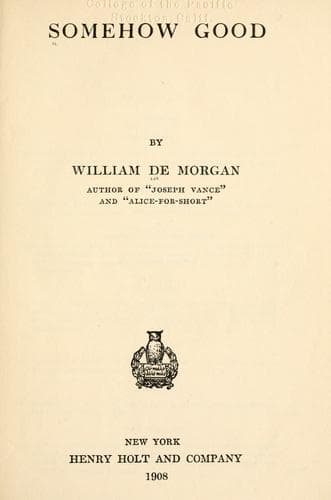
Amnesiacs -- Fiction; England -- Fiction; Mothers and daughters -- Fiction
The ladies then lost sight of their topic, which lapsed into a rather
heated discussion of whether the very old gentleman was a Colonel or
a Major. As we don't want to hear them on this point, we may let them
lapse too.
It may have been because of some home anxieties--notably about the
Major, whose bronchitis had been bad--that Rosalind Fenwick continued
happily unconscious of having incurred any blame or taken any
responsibility on herself in connexion with the Ladbroke Grove row,
as Sally called it. If she _had_ known of it, very likely it would
not have troubled her, for she was really too contented with her own
condition and surroundings to be concerned about externals. Whatever
troubles she had were connected with the possibility, which always
seemed to grow fainter, of a revival of her husband's powers of memory.
Sometimes whole weeks would pass without an alarm. Sometimes some
little stirring of the mind would occur twice in the same day; still,
the tendency seemed to be, on the whole, towards a more and more
complete oblivion.
But the fact is that so long as she had the Major invalided at Krakatoa
Villa (for he was taken ill there, and remained on her hands many
weeks before he could return to his lodgings) she had the haziest
impressions of the outside world. Sally talked about "the row" while
they were nursing the old boy, but really she heeded her very little.
Then, when the invalid was so far reinstated that he was fit to be
moved safely, Sally went away too, for a change.
The respite to old Colonel Lund was not to be for long. But the rest,
alone with her husband, was not unwelcome to Rosalind.
"I can never have been one-tenth as happy, Rosey darling," said he to
her one day, "as I have been in the last six months. I should recollect
all about it if I had."
"You're a satisfactory chap to deal with, Gerry--I must say that for
you. You always beam, come what may. Even when you fly out--which you
do, you know--it's more like a big dog than a wasp. You were
always...." Now, Rosalind was going to say "always like that"; it was
a mistake she was constantly in danger of. But she stopped in time,
and changed her speech to "You're not without your faults, you know!
You never can come to an anchor, and be quiet. You sit on the arms of
chairs, and your hands are too big and strong. No; you needn't stop. Go
on!" We like leaving the words to elucidate the concurrent action. "And
you don't smell much of tobacco."
Fenwick, however, had noticed the kink in the thread, and must needs
wind it back to get a clear line. "I was always what?" said he. His
wife saw a way out.
"Always good when your daughter was here to manage you." It wasn't so
satisfactory as it might have been, but answered in dealing with a mind
so unsuspicious. Sally's having spent Christmas and stayed on a little
at a friend's in the country lent plausibility to a past tense which
might else have jarred.
Public-domain text, read in full here on John Shaqi.
Reviews
Reviews
No reviews yet
Be the first to share your thoughts on this work.
Elsewhere in the archive
Join the Discussion
Join the discussion
Sign in to leave a comment or review.
Sign InorCreate an account