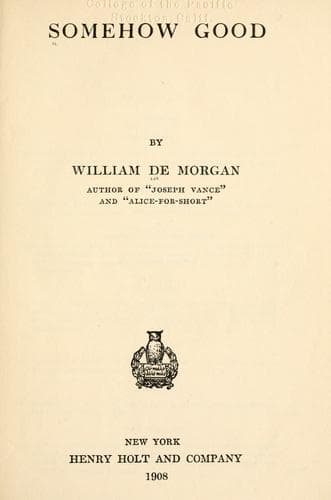
Amnesiacs -- Fiction; England -- Fiction; Mothers and daughters -- Fiction
"But then Shakespeare might have gone on and written a dry respectable
story--not a love-story; an esteem story--about how Juliet took an
interest in Romeo's welfare, and Romeo posted her letters for her, and
presented her with a photograph album, and so on. And how the families
left cards."
"But it isn't exactly stony geniality. It's another method altogether
with the doctor--a method the child's invented for herself."
Fenwick repeats, "A method she's invented for herself. Exactly. Well,
we shall have her back to-morrow. What time does she come?" And then
her mother says, interrupting the conversation: "What's that?"
"What's what?"
"I thought I heard the gate go."
"Not at this time of night." But Fenwick is wrong, for in a moment
comes an imperious peal at the bell. A pair of boots, manifestly on
a telegraph-boy's cold feet, play a devil's tattoo on the sheltered
doorstep. They have been inaudible till now, as the snow is on the
ground again at Moira Villas. In three minutes the boots are released,
and they and their wearer depart, callously uninterested in the
contents of the telegram they have brought. If we were a telegraph-boy,
we should always be yearning to know and share the joys and sorrows of
our employers. This boy doesn't, to judge by the way he sings that he
is "Only the Ghost of a Mother-in-law," showing that he goes to the
music-halls.
* * * * *
Less than ten minutes after the telegraph-boy has died away in the
distance Rosalind and her husband are telling a cab to take them to
174, Ball Street, Mayfair.
It does so grudgingly, because of the state of the roads. It wants
three-and-sixpence, and gets it, for the same reason. But it doesn't
appear to be drawn by a logical horse who can deal with inferences,
because it is anxious to know when its clients are going back, that
it may call round for them.
For the telegram was that there was "no cause immediate apprehension;
perhaps better come--Major." As might have been expected from such
a telegram about a man of his age, just after seeming recovery from an
attack of bronchitis, the hours on earth of its subject were numbered.
Fever may abate, temperature may be brought down to the normal, the
most nourishing possible nourishment may be given at the shortest
possible intervals, but the recoil of exhaustion will have its way when
there is little or nothing left to exhaust. Colonel Lund had possibly
two or three years of natural life before him, disease apart, when
a fierce return of the old enemy, backed by the severity of a London
winter, and even more effectually by its fog, stopped the old heart a
few thousand beats too soon, and ended a record its subject had ceased
to take an interest in a few paragraphs short of the normal _finis_.
Public-domain text, read in full here on John Shaqi.
Reviews
Reviews
No reviews yet
Be the first to share your thoughts on this work.
Elsewhere in the archive
Join the Discussion
Join the discussion
Sign in to leave a comment or review.
Sign InorCreate an account