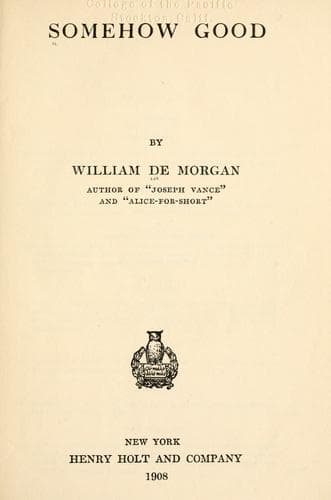
Amnesiacs -- Fiction; England -- Fiction; Mothers and daughters -- Fiction
"I shall have to finesse a good deal. I can manage with Mrs. Fenwick.
But--I wish I felt equally secure with Miss Sally." He feels very
insecure indeed in that quarter, if the truth is told. And he is
afflicted with a double embarrassment here, as he has never left Sally
without her "miss" in speaking to Fenwick, while, on the other hand,
he holds a definite licence from her mother--is, as it were, a
chartered libertine. But that's a small matter, after all. The real
trouble is having to look Sally in the face and conceal anything.
"Miss who?" says Fenwick. "Oh--Sally, you mean! Of course she'll
rush the position. Trust her!" He can't help laughing as he thinks
of Sally, with Dr. Conrad vainly trying to protect his outworks.
The momentary hesitation about how to speak of Sally may have
something to do with Vereker's giving the conversation a twist. It
turns, however, on a point that has been waiting in his mind all
through their interview, ever since Fenwick spoke of his identity
with Harrisson.
"Look here, Fenwick," he says. "It's all very fine your talking about
keeping Mrs. Fenwick in the dark about this. I know it's for her own
sake--but you can't."
"And why not? I can't have Rosey know I have another wife living...."
"You don't know she's alive, for one thing!"
"H'm!... I don't _know_, certainly. But I should have known, somehow,
if she were dead. Of course, if further memory or inquiry proves that
she _is_ dead, that's another matter."
"But, in the meanwhile, how can you prove your identity with Harrisson
and claim all your property without her knowing?... What I mean is,
I can't think it out. There may be a way...."
"My dear boy"--Fenwick says this very quietly--"that's exactly the
reason why I said you would have to help me to settle whether I should
be that man again or not. I say _not_, if the decision lies with me."
"Not?--not _at all_?" The doctor fairly gasps; his breath is taken
away. Never perhaps was a young man freer from thought and influence
of money than he, more absorbed in professional study and untainted
by the supremacies of property. But for all that he was human, and
English, and theoretically accepted gold as the thing of things, the
one great aim and measure of success. Of other men's success, that
is, and _their_ aim, not his. For he was, in his own eyes, a humble
plodder, not in the swim at all. But he ascribed to the huge sums real
people had a right to, outside the limits of the likes of him, a kind
of sacredness that grew in a geometrical ratio with their increase.
It gave him much more pain to hear that a safe had been robbed of
thousands in gold than he felt when, on opening a wrapped-up fee,
what seemed a guinea to the touch turned out a new farthing and a
shilling to the sight. It was in the air that he lived in--that all
of us live in.
Public-domain text, read in full here on John Shaqi.
Reviews
Reviews
No reviews yet
Be the first to share your thoughts on this work.
Elsewhere in the archive
Join the Discussion
Join the discussion
Sign in to leave a comment or review.
Sign InorCreate an account