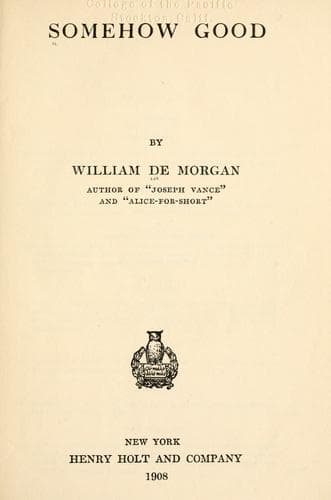
Amnesiacs -- Fiction; England -- Fiction; Mothers and daughters -- Fiction
It seemed so cruelly hard to Rosalind that it might not be. What had
she to gain by the revival of a forgotten past--a past her own share
of which she had for twenty years striven to forget? Utterly guiltless
as, conceivably, she may have known herself to be, she had striven
against that past as the guilty strive with the memory of a concealed
crime. And here was she, at the end of this twenty years, with all
she most longed for at the beginning in her possession, mysteriously
attained with a thoroughness no combination of circumstances, no
patience or forbearance of her own, no self-restraint or generosity of
her young husband's could possibly have brought about. Think only of
what we do know of this imperfect story! Conceive that it should have
been possible for the Algernon Palliser of those days to know and
understand it to the full; indulge the supposition, however strained
it may be, that his so knowing it would not have placed him in a
felon's dock for the prompt and righteous murder of the betrayer--we
take the first convenient name--of the woman he loved. Convince
yourself this could have been; figure to yourself a happy wedded
life for the couple after Miss Sally had made her unconscious _debut_
with the supremest indifference to her antecedents; construct a
hypothetical bliss for them at all costs, and then say if you can
fill out the picture with a relation between Sally and her putative
father to be compared for a moment to the one chance has favoured
now for the stepfather and stepdaughter of our story.
Our own imagination is at fault about the would-have-beens and
might-have-beens in this case. The only picture our mind can form of
what would have followed a full grasp of all the facts by Algernon
Palliser may be dictated or suggested by a memory of what sent Mr.
Salter, of Livermore's Rents, 1808, to the hospital. Rosalind knew
nothing of Mr. Salter, but she could remember well all Gerry's feats
of strength in his youth--all the cracking of walnuts in his
arm-joints and bending of kitchen-pokers across his neck--and also,
too well, an impotence against his own anger when provoked; it had
died down now to a trifle, but she could detect the trifle still.
Was such an executive to be trusted not to take the law into its own
hands, to fall into the grasp of an offended legislative function
later--one too dull to be able to define offence so as to avoid the
condemnation, now and again, of a culprit whose technical crime has
the applause of the whole human race? Had the author of all her
wrongs met his death at the hands of her young husband, might not
this husband of her later life--beside her now--be still serving his
time at the galleys, with every compulsory sharer in his condemnation
thinking him a hero?
It was all so much better as it had turned out. Only, could it
remain so?
Public-domain text, read in full here on John Shaqi.
Reviews
Reviews
No reviews yet
Be the first to share your thoughts on this work.
Elsewhere in the archive
Join the Discussion
Join the discussion
Sign in to leave a comment or review.
Sign InorCreate an account