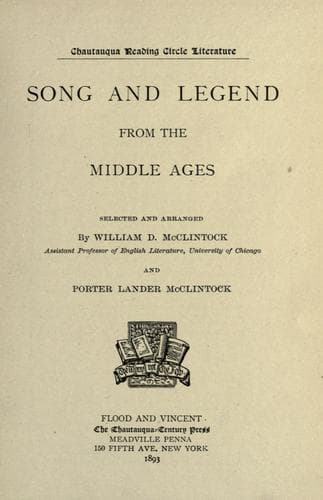
Literature, Medieval -- History and criticism; Literature, Medieval -- Translations into English
After writing this sonnet, it was given unto me to behold a very
wonderful vision,[1] wherein I saw things which determined me
that I would say nothing further of this most blessed one, until
such time as I could discourse more worthily of her. And to this
end I labor all I can; as she well knoweth. Wherefore if it be
His pleasure through whom is the life of all things, that my life
continue with me a few years, it is my hope that I shall yet
write concerning her what hath not before been written of any
woman. After the which may it seem good unto Him who is the
Master of Grace, that my spirit should go hence to behold the
glory of its lady: to wit, the blessed Beatrice, who now gazeth
continually on His countenance qui est per omnia soecula
benedictus. Laus Deo.[2]
[1] This we may believe to be the vision of Hell, Purgatory, and
Paradise, the vision which gave him the argument of the Divine
Comedy.
[2] Who is blessed throughout all ages. Praise to God.
FROM THE DIVINE COMEDY.[1]
[1] Dante called his poem a comedy, he says, for two reasons:
because it has a sad beginning and a cheerful ending, and because
it is written in a "middle" style, treating alike of lowly and
lofty things. Midway in life the poet finds himself lost in the
forest of worldly cares, beset by the three beasts, Pride,
Avarice, and Worldly Pleasure. Virgil, who is the embodiment of
moral philosophy, appears and leads him through the Hell of
worldly sin and suffering, through the Purgatory of repentance,
to the calm of the earthly Paradise. Mere philosophy can go no
further. The poet is here taken under the guidance of Beatrice,
the embodiment of divine wisdom, who leads him through Paradise
to the throne of God. Such, in the briefest form, is the argument
of the Divine Comedy; this statement carries the actual story and
the allegory side by side. The first division of the triple
vision is the Inferno. Dante's Inferno is an inverted cone,
having its mouth in a deep rugged valley, its sides sloping down
to the center of the earth. When Lucifer fell from heaven the
earth retired before him, making this hollow cone. This is
divided into nine circles, in which the lost souls suffer. These
souls are grouped into three main classes: the incontinent, the
violent, and the fraudulent. The first circle of the Inferno is
Limbo, where are the souls of children and the unbaptized; of the
heathen philosophers and poets. They are neither in pain nor
glory, they do not shriek nor groan but only sigh.
I. The Poets in Limbo.--From the Inferno.
Public-domain text, read in full here on John Shaqi.
Reviews
Reviews
No reviews yet
Be the first to share your thoughts on this work.
Elsewhere in the archive
Join the Discussion
Join the discussion
Sign in to leave a comment or review.
Sign InorCreate an account