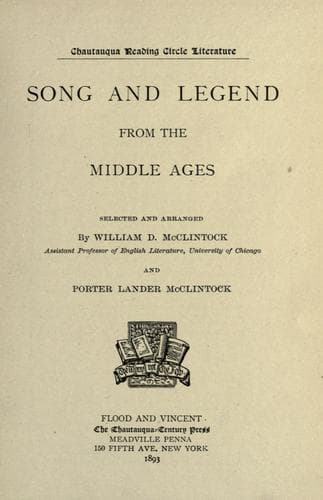
Literature, Medieval -- History and criticism; Literature, Medieval -- Translations into English
There in the depth we saw a painted tribe,
Who paced with tardy steps around, and wept,
Faint in appearance and o'ercome with toil.
Caps had they on, with hoods, that fell low down
Before their eyes, in fashion like to those
Worn by the monks in Cologne.[1]
Their outside Was overlaid with gold, dazzling to view,
But leaden all within, and of such weight,
That Frederick's [2] compared to these were straw.
Oh, everlasting wearisome attire!
We yet once more with them together turn'd
To leftward, on their dismal moan intent.
But by the weight opprest, so slowly came
The fainting people, that our company
Was changed, at every movement of the step.
I staid, and saw two spirits in whose look
Impatient eagerness of mind was mark'd
To overtake me; but the load they bare
And narrow path retarded their approach.
Soon as arrived, they with an eye askance
Perused me, but spake not: then turning, each
To other thus conferring said: "This one
Seems, by the action of his throat, alive;
And, be they dead, what privilege allows
They walk unmantled by the cumbrous stole?"
Then thus to me: "Tuscan, who visitest
The college of the mourning hypocrites,
Disdain not to instruct us who thou art."
"By Arno's pleasant stream," I thus replied,
In the great city I was bred and grew,
And wear the body I have ever worn.
But who are ye, from whom such mighty grief,
As now I witness, courseth down your cheeks?
What torment breaks forth in this bitter woe?"
"Our bonnets gleaming bright with orange hue,"
One of them answer'd' "are so leaden gross,
That with their weight they make the balances
To crack beneath them. Joyous friars[3] we were,
Bologna's natives; Catalano I,
He Loderingo named; and by thy land
Together taken, as men use to take
A single and indifferent arbiter,
To reconcile their strifes. How there we sped,
Gardingo's vicinage [4] can best declare."
"O friars!" I began, "your miseries--"
But there brake off, for one had caught mine eye,
Fix'd to a cross with three stakes on the ground:
He, when he saw me, writhed himself, throughout
Distorted, ruffling with deep sighs his beard.
And Catalano, who thereof was 'ware,
Thus spake: "That pierced spirit,[5] whom intent
Thou view'st, was he who gave the Pharisees
Counsel, that it were fitting for one man
To suffer for the people. He doth lie
Transverse; nor any passes, but him first
Behoves make feeling trial how each weighs.
In straits like this along the foss are placed
The father of his consort,[6] and the rest
Partakers in that council, seed of ill
And sorrow to the Jews."
[1] The monks in Cologne. These monks wore their cowls unusually
large.
[2] Frederick's. Frederick II. punished those guilty of high
treason by wrapping them up in lead, and casting them into a
furnace.
[3] Joyous friars. An order of knights (Frail Godenti) on two of
whom the Ghibelline party at one time conferred the chief power
of Florence. One was Catalano de' Malavolti, the other Loderingo
di Liandolo. Their administration was unjust.
Public-domain text, read in full here on John Shaqi.
Reviews
Reviews
No reviews yet
Be the first to share your thoughts on this work.
Elsewhere in the archive
Join the Discussion
Join the discussion
Sign in to leave a comment or review.
Sign InorCreate an account