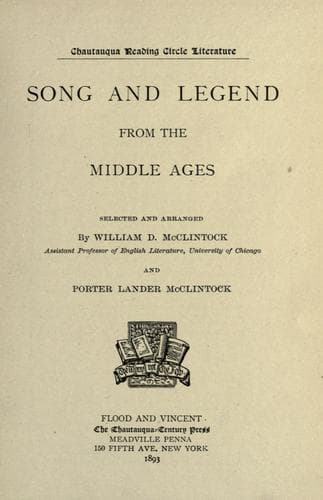
Literature, Medieval -- History and criticism; Literature, Medieval -- Translations into English
Next after Dante, the first name of importance in Italian
literature is that of Francesca Petrarca, called Petrarch in
English. He was the son of a Florentine exile, was born at Aruzzo
in 1304, and died at Padua in 1374. He was a scholar and a
diplomat, and was entrusted with many public services. Most of
his active life he spent at Avignon, at the papal court, or in
Vaucluse near by. When he was twenty-three, he met Laura, the
beautiful woman with whom he was always after in love, and who
was the inspiration of all his lyric poetry. She was the daughter
of a citizen of Avignon, and was married, probably to Ugo de Sade
of Avignon. She was a good woman whose character was ever above
reproach. Petrarch was a very industrious writer. He produced
many letters and treatises in Latin, besides a long Latin epic
Africa. But his great and deserved fame rests upon his Italian
lyric poetry--the Canzoniere. The Canzoniere is divided into
three parts: the poems to Laura in life; to Laura in death; and
the Triumphs. The Triumphs are inferior in merit to the other two
parts. He had studied closely the Provencall poets, and had
something of their spirit.
I. To Laura in Life.
SONNET III. HE BLAMES LOVE FOR WOUNDING HIM ON A HOLY DAY (GOOD
FRIDAY).
'Twas on the morn' when heaven its blessed ray
In pity to its suffering master veil'd,
First did I, Lady, to your beauty yield,
Of your victorious eyes th' unguarded prey.
Ah! little reck'd I that, on such a day,
Needed against Love's arrows any shield;
And trod' securely trod, the fatal field:
Whence, with the world's, began my heart's dismay.
On every side Love found his victim bare,
And through mine eyes transfix'd my throbbing heart;
Those eyes, which now with constant sorrows flow:
But poor the triumph of his boasted art,
Who thus could pierce a naked youth nor dare
To you in armour mail'd even to display his bow!
--Wrangham.
SONNET XIV. HE COMPARES HIMSELF TO A PILGRIM.
The palmer bent, with locks of silver gray,
Quits the sweet spot where he has pass'd his years,
Quits his poor family, whose anxious fears
Paint the loved father fainting on his way;
And trembling, on his aged limbs slow borne,
In these last days that close his earthly course,
He, in his soul's strong purpose, finds new force,
Though weak with age, though by long travel worn:
Thus reaching Rome, led on by pious love,
He seeks the image of that Saviour Lord
Whom soon he hopes to meet in bliss above:
So, oft in other forms I seek to trace
Some charm, that to my heart may yet afford
A faint resemblance of thy matchless grace.
--Dacre
SONNET XCVIII. LEAVE-TAKING.
Public-domain text, read in full here on John Shaqi.
Reviews
Reviews
No reviews yet
Be the first to share your thoughts on this work.
Elsewhere in the archive
Join the Discussion
Join the discussion
Sign in to leave a comment or review.
Sign InorCreate an account