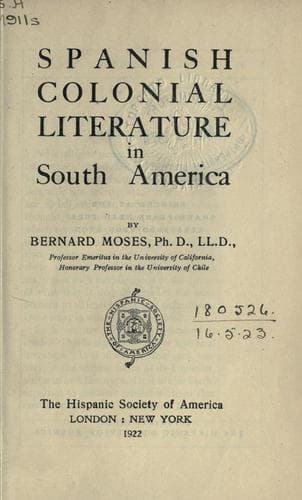
Spanish colonial literature in South AmericaMoses, Bernard
History
Spanish colonial literature in South America
Moses, Bernard
Spanish American literature -- History and criticism
“The tyrant Lope de Aguirre was a man about fifty years old, small
of stature and of an insignificant presence: ugly, with a small and
emaciated face; eyes, which, if he looked fixedly, were restless in
their sockets especially when he was offended. He had a keen and active
mind for an unlettered person. He was a Biscayan, and, according to his
statement, was born at Oñate in the province of Guipuzcoa. He was,
however, unable to find out who his parents were, more definitely than
what he communicated in a letter which he wrote to king Philip, in
which he affirmed that he was an hidalgo; but judging him by his acts,
he appears so cruel and perverse that there was not found or could be
observed in him any goodness or virtue. He was turbulent and determined,
particularly with his followers. He was a great sufferer from certain
difficulties, especially as to sleeping, so that during all the time of
his tyrannical rule he was seldom seen to sleep; except during a brief
period in the day, he was always found awake. He walked much, and always
burdened with considerable weight; he carried continually many arms on
his back; went about often wearing two heavy coats of mail, with a sword,
a dagger, and steel helmet, and carrying an arquebuse or a lance in his
hand. At other times he wore a breastplate. He was naturally an enemy of
the good and virtuous, and thus all virtuous and saintly acts appeared
to him as bad. He was a friend and companion of low and vile men, and
if one was a thief, or had a bad character, or was cruel, he was all the
more Aguirre’s friend. He was always cautious, inconstant, false, and
a deceiver; he was seldom known to tell the truth, and never, or very
seldom, kept his word. He was vicious, lustful, gluttonous with all and
often overcome with wine. He was a bad Christian, a Lutheran heretic or
worse, for he did and said the things we have told in this narrative, the
killing of priests, friars, women, and innocent persons for no fault, and
without giving them an opportunity to confess, although they requested
it, and preparations had been made. He had as a common vice commending
his soul and body to the devil, mentioning his head, his legs, his arms,
and all members. He never spoke a word without blasphemy and cursing
God and His saints. He neither knew how to speak well nor spoke well of
anybody, not even of his friends; he was a defamer of everything; and,
finally there was no vice that was not represented in his person.”[116]
III
[Sidenote: Cristóbal de Acuña]
[Sidenote: Acuña on the Amazon]
Public-domain text, read in full here on John Shaqi.
Reviews
Reviews
No reviews yet
Be the first to share your thoughts on this work.
Elsewhere in the archive
Join the Discussion
Join the discussion
Sign in to leave a comment or review.
Sign InorCreate an account