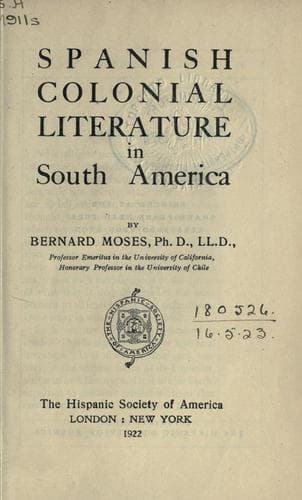
Spanish colonial literature in South AmericaMoses, Bernard
History
Spanish colonial literature in South America
Moses, Bernard
Spanish American literature -- History and criticism
The life of Carvallo was that of a vigorous and restless spirit in revolt
against the narrowness and monotony of Chilean social conditions in the
last half of the eighteenth century. He was born in Valdivia in 1742, the
son of the governor of the district, and the youngest of three brothers.
Until his twentieth year he was under the instruction of Jesuits; he then
entered the military service, in which he continued for many years in his
native city, where he married and became the head of a numerous family.
The dull routine of garrison duties in a stagnant colonial town irked
him. Hoping to find an open field for his ambition, he sought and secured
his transfer to the frontier. At this time the project of President
Guill y Gonzaga to establish towns or forts on territory not previously
occupied by the Spaniards provoked the opposition and hostility of the
Indians. It would be difficult to imagine a more complete contrast to
Carvallo’s life at Valdivia than that presented by his experience on the
frontier; but the freer life of the frontier had its compensations; he
found there abundant material for the diary which he kept throughout the
whole period of his military career. The writing of this diary is said to
have suggested to him the project to write a history of Chile. Moreover,
daily contact with the Indians for more than thirty years gave him a
secure basis of judgment concerning the long conflict which furnishes
the main theme of Chilean history; he acquired sufficiently the Indians’
viewpoint to enable him to discern the unjust features of the Spanish
policy respecting them, and by his spirit of impartiality he was led to
oppose the governors and to point out their abuses and unworthy conduct.
When Carvallo finally obtained permission directly from the government in
Spain to visit Madrid, O’Higgins sent to Buenos Aires an order for his
arrest, but the order arrived too late to prevent Carvallo’s departure,
and he was consequently able to pass a number of years in the Spanish
capital, where he completed his History of Chile in 1796.
[Sidenote: Carvallo at Madrid]
At Madrid Carvallo was able to command influence sufficient not only to
defeat the efforts of those who wished to excite hostility to him at the
court, but also to secure the favour of the king and incorporation in the
army at Buenos Aires. It is not definitely known how long he remained
at Madrid, long enough, however, as already indicated, to complete his
manuscript, the narrative of which extends to 1788, to the end of the
_interim_ government of Tomás Álvarez de Acevedo. He was not able to
secure its publication, but before it was printed it was extensively
used as a source by later writers. Two of the volumes of Gay’s _Historia
física y política de Chile_, as pointed out by Amunátegui, “are a simple
transcription of some of the books of Carvallo’s work.”
[Sidenote: Carvallo’s death and legacy]
Public-domain text, read in full here on John Shaqi.
Reviews
Reviews
No reviews yet
Be the first to share your thoughts on this work.
Elsewhere in the archive
Join the Discussion
Join the discussion
Sign in to leave a comment or review.
Sign InorCreate an account