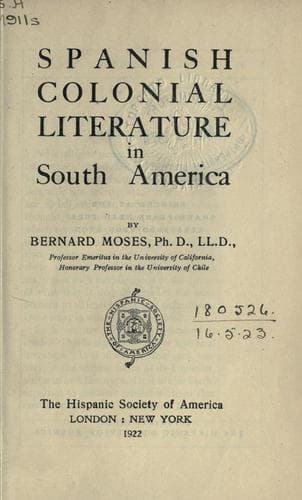
Spanish colonial literature in South AmericaMoses, Bernard
History
Spanish colonial literature in South America
Moses, Bernard
Spanish American literature -- History and criticism
Prior to the founding of the _Mercurio peruano_ there had existed a
periodical for the presentation of economic and commercial subjects
called _Diario erudito_, which ceased publication at the end of its
second year. The first number of the _Mercurio_ appeared on the first
of January, 1791, under the editorial direction of Jacín de Calero y
Moreyra. The periodical itself was designed to treat of scientific,
political, commercial, historical, and statistical subjects, in a manner
hitherto quite unknown in the colonies. It was continued until eleven
volumes had been completed by the association; and on the failure of
funds to meet further expenses of publication, Padre Cisneros, who had
succeeded the former secretary of the society caused a twelfth volume
to be printed at his own expense. In this year, 1791, there was formed,
moreover, a new society called “Tertulia poética,” which held frequent
meetings for the examination of articles or poems presented, some of
which were published in the _Mercurio peruano_.
[Sidenote: _Gaceta de Lima_]
[Sidenote: Anti-revolutionary propaganda]
In 1793 the viceroy decided to publish a _Gaceta de Lima_, reviving a
title that had been used in the middle of the century, in order that the
inhabitants of the viceroyalty might have a properly accredited journal
that would inform them regarding the excesses of the French Revolution,
of which various rumours were reaching their ears. For this purpose the
viceroy concluded that it would be better to have an independent journal
rather than to give to the _Mercurio peruano_ an official character.
The number of the persons associated with the _Mercurio_ would make it
practically impossible to prevent their intervention in the determination
of what should be published. These persons, for the greater part,
were men of high ideals and not in sympathy with all of the views and
practices of the government, and the viceroy had doubtless reason to
believe that their interference would furnish a source of embarrassment,
for he evidently did not propose, in the gazette, to present the
unvarnished truth, but, on the other hand, through its pages, to carry
on a propaganda against revolutionary doctrines, free criticism of the
Church, and republican attacks on the absolute state. The _Gaceta_ was
continued until 1821; and it made public only such facts or documents
as the government wished to have known, in other words, falsified and
garbled information.
V
[Sidenote: Hipólito Unánue]
Public-domain text, read in full here on John Shaqi.
Reviews
Reviews
No reviews yet
Be the first to share your thoughts on this work.
Elsewhere in the archive
Join the Discussion
Join the discussion
Sign in to leave a comment or review.
Sign InorCreate an account