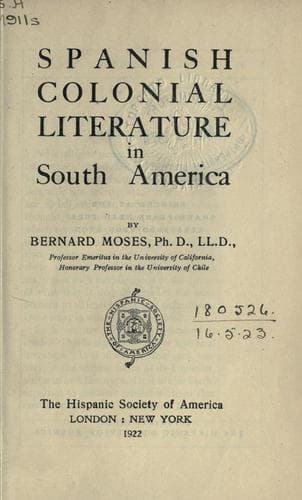
Spanish colonial literature in South AmericaMoses, Bernard
History
Spanish colonial literature in South America
Moses, Bernard
Spanish American literature -- History and criticism
The noteworthy success achieved by the _Mercurio peruano_ was one of the
inducements leading to the establishment of _El telégrafo mercantil_
at Buenos Aires in 1801. The founder and editor was Francisco Antonio
Cabello. His announced purpose in founding this periodical was to advance
science and the arts, to create a school of philosophy that would
banish the barbarous forms of scholasticism, to extend the knowledge
of agriculture, and to inform the readers of the progress and new
discoveries in history, archæology, literature and other departments
of human learning. The first number was issued on April 1, 1801, and
it appeared thereafter during its continuance generally twice a week.
The first volume of thirty-five numbers covered the months of April,
May, June and July; the second volume, September, October, November,
and December; the third volume, January, February, March and April, of
1802; the fourth volume, May, June, July, and August; but the fifth and
last volume was never completed. It’s fourth number, the last issued,
appeared on October 17, 1802; it contained an article which the public
found extremely objectionable. In this article the editor wrote that
there existed no place under the sun more effective than Río de la Plata
for encouraging the idleness of foreigners, on account of the abundance
of food and of the superabundance of unmarried women, lovers of society
and of luxury. And in order to remedy this evil this article further
proposed that towns should be built on the coast of Patagonia; that all
Spanish bachelors in the country should be arrested and induced to marry;
and afterwards sent to the new Patagonian towns under penalty of a forced
return to Spain of all those who would not accept the hand of some poor
young woman of Buenos Aires, and who would not be willing to establish
themselves either at the bay of San Julián or the bay of San Matías.
[Sidenote: The end and character of the _Telégrafo_]
[Sidenote: Influence of the _Telégrafo_]
Public-domain text, read in full here on John Shaqi.
Reviews
Reviews
No reviews yet
Be the first to share your thoughts on this work.
Elsewhere in the archive
Join the Discussion
Join the discussion
Sign in to leave a comment or review.
Sign InorCreate an account