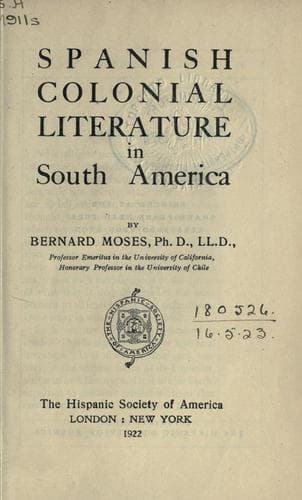
Spanish colonial literature in South AmericaMoses, Bernard
History
Spanish colonial literature in South America
Moses, Bernard
Spanish American literature -- History and criticism
The expedition sailed northward along the coast, and the most important
halt was in the port of Callao. The ships were left under the necessary
guard, and the members of the company established themselves for four
months in the valley of the Rimac. The viceroy Francisco de Gil y Lemus
received the officers and the scientists, but the festivities of the
viceregal court did not prevent somewhat elaborate investigations in
Peru. Haenke accompanied by the botanist Tafalla and the draughtsman
Pulgar, went over the Andes to Tarma and visited Huanuco and the mines
of Cerro del Pasco. Tafalla and Pulgar had been associated with the
botanical expedition under Ruiz and Pavón, and after its return to
Spain, they remained under orders from the government to continue their
botanical investigations in Peru, and to make collections to replace
those that had been lost at Macora.
[Sidenote: Voyage northward and to the Far East]
[Sidenote: Haenke leaves the expedition]
Towards the end of 1790 Malaspina’s expedition continued its northward
voyage, halting at Guayaquil, Panama, Acapulco, and advancing to the
Strait of Fuca and into the Behring Sea. In the beginning of 1792 it
entered upon the voyage across the Pacific, to the Philippine Islands and
Australia, and, returning, arrived at Callao July 23, 1793. This long
voyage was for Haenke a period of fatiguing and profitless idleness;
and when the expedition started on its homeward voyage from Peru it was
determined by Malaspina and approved by the viceroy that Haenke should
be temporarily separated from the ships and go to Buenos Aires by way
of Huancavelica, Cuzco and Potosí, for the purpose of continuing his
investigations in botany and zoology. Luis Nee, another member of the
scientific staff, was permitted to leave the “Atrevida” at Concepción
in Chile, and proceed by land to Buenos Aires and meet the ships at
Montevideo. But Haenke, on account of the great extent of his proposed
journey, had permission to delay his arrival in Buenos Aires until
October or November 1794. Nee complied with the stated requirements,
rejoined the expedition at Montevideo, and returned to Spain. Haenke,
on the other hand, failed to carry out the conditions under which he
was permitted to cross the continent. Letters from him received by his
companions at Montevideo announced that on account of the extent of his
explorations, reaching to the territory of the Mojos and Chiquitos, he
would be delayed beyond the time specified for his arrival in Buenos
Aires, but that he believed he would be in Montevideo and embark for
Europe in the early part of the following year.
[Sidenote: Haenke’s Writings]
Public-domain text, read in full here on John Shaqi.
Reviews
Reviews
No reviews yet
Be the first to share your thoughts on this work.
Elsewhere in the archive
Join the Discussion
Join the discussion
Sign in to leave a comment or review.
Sign InorCreate an account