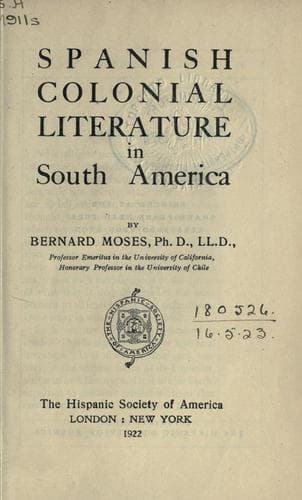
Spanish colonial literature in South AmericaMoses, Bernard
History
Spanish colonial literature in South America
Moses, Bernard
Spanish American literature -- History and criticism
Perhaps to these indications of an intellectual awakening in Spanish
South America one ought to add a reference to a forerunner of modern
aviation, who achieved fame to such an extent that he became known as
El Volador. This was Santiago Cárdenas, who was born in Callao about
1726. Here he lived with his parents, who were extremely poor, until
they secured for him, while he was still very young, a position on a
vessel trading between Callao and the coast of Chile. The tidal wave
that succeeded the earthquake of 1746 threw the vessel, to which he was
attached, upon the shore. This event deprived the seafaring life of some
of its attractions for him, and he left his service and went to Lima.
Here he devoted himself to work in practical mechanics. Having acquired
noteworthy skill in this field, he became ambitious to invent a machine
for flying, and petitioned Viceroy Amat for support to enable him to
carry out his project. The inhabitants of Lima did not receive with
favour his proposal to fly from the hill San Cristóbal to the great
square of the city, and on his appearance on the streets they hooted at
him and stoned him. The government, however, intervened, and set aside
the proposed attempt. Thereafter El Volador’s efforts were directed to
writing a book on flying, which he called _Nuevo sístema de navegar por
les aires_.
[Sidenote: On art of flying]
In 1860 the manuscript of this book was in the library of the school of
medicine; it was afterwards transferred to the national library at Lima,
but some pages at the end had been lost, as also some of the rude pen
drawings. But in 1878 Ricardo Palma had the manuscript copied and printed
at Valparaiso in a little volume of one hundred and thirty pages. In the
introduction he set down certain curious facts regarding Cárdenas. The
next year Pedro Ruiz published a pamphlet in which he discussed the art
of flying. Mendiburu, from whose notice of the Volador these facts are
taken, refers to a manuscript in the library of Lima entitled _Viaje al
globo de la luna_, giving some account of Santiago El Volador. In the
course of time the populace recovered from its aversion to Cárdenas’
project, and it is reported that he had to seek asylum in a church to
escape from the crowd that wished to compel him to fulfil his promise to
fly.
[Sidenote: Intellectual movement in the last decades]
[Sidenote: Mutis and Nariño]
Public-domain text, read in full here on John Shaqi.
Reviews
Reviews
No reviews yet
Be the first to share your thoughts on this work.
Elsewhere in the archive
Join the Discussion
Join the discussion
Sign in to leave a comment or review.
Sign InorCreate an account