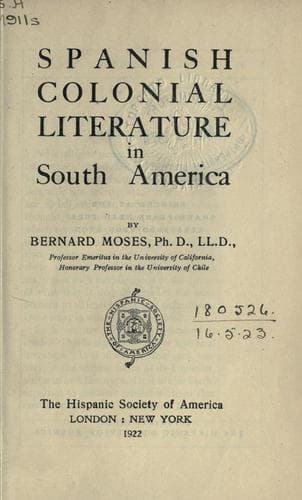
Spanish colonial literature in South AmericaMoses, Bernard
History
Spanish colonial literature in South America
Moses, Bernard
Spanish American literature -- History and criticism
Diego Fernández, on the title-page of his _Primera y segunda parte de
la historia del Perú_, identifies himself as “vecino de la ciudad de
Palencia.” He took part in the campaign against Francisco Girón in 1554,
and the subject of his narrative was Peru in the most stormy period of
its early history, the period of the introduction of the New Laws, the
rebellion of Gonzalo Pizarro, the mission of President Gasca, and the
labours of the Viceroy Hurtado de Mendoza (1555-1561) to bring order out
of the social chaos. This volume was published in Seville in 1571, but
its sale was prohibited for a time because it contained certain ideas and
statements which it was desired should not be circulated in America. On
questions relating to the civil wars and the conflicts growing out of the
introduction of the New Laws, the population of Peru was still divided
in 1571, and any discussion of these events by a person who had had an
active part in them would inevitably have provoked antagonism and kept
alive the hostility of the two parties.[21]
VI
To the later part of the period of the Pizarros belongs the account
given by Agustín de Zárate, who was sent to Peru to take charge of the
accounts of the “kingdoms and provinces of Peru,” at the time that
Blasco Núñez Vela was commissioned to become the first viceroy of the
Spanish possessions in South America. Zárate had part in the conflicts
occasioned by the arrival of Núñez Vela and the rebellion of Gonzalo
Pizarro. He was one of the two commissioners sent by the oidores to order
Pizarro to disband his army, which he held at Jauja, and enter Lima with
only a small escort. Pizarro, however, sent out Captain Villegas, who met
Zárate on the way, arrested him, took away his commission, confiscated
his provisions, and imprisoned him at Huarochiri. Released after some
days, he was persuaded to return to Lima, and it was suggested that in
consideration of his release he should urge the audiencia to leave the
government to Gonzalo Pizarro. Whatever may have been the influence of
Zárate in this matter, Pizarro not long afterwards approached the capital
and assumed the reins of government.
[Sidenote: Zárate’s _Historia del Perú_]
Having played his part in this turbulent period, a part regarding which
writers venture a variety of opinions, Zárate returned to Spain, and,
using notes made in America, wrote the _Historia del descubrimiento y
conquista de la provincia del Perú_. His final plan for this work was
to treat of the discovery and occupation of the country, and to narrate
the principal events in the history of the colony until the pacification
that followed the intervention of Pedro de la Gasca. The author is said
to have intended that his work should remain in manuscript until after
his death, but that under the persuasion, perhaps the orders, of Prince
Philip, to whom he had presented it, he caused it to be printed in
Antwerp in 1555.[22]
[Sidenote: Pizarro pays Alvarado]
[Sidenote: Almagro goes to Cuzco]
Public-domain text, read in full here on John Shaqi.
Reviews
Reviews
No reviews yet
Be the first to share your thoughts on this work.
Join the Discussion
Join the discussion
Sign in to leave a comment or review.
Sign InorCreate an account