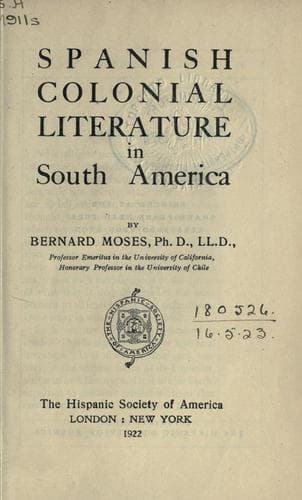
Spanish colonial literature in South America — John Shaqi
Spanish colonial literature in South AmericaMoses, Bernard
History
Spanish colonial literature in South America
Moses, Bernard
Spanish American literature -- History and criticism
Molina’s _Conquista y población del Perú_ was written in Lima. It was
printed for the first time in 1873 in _Sud-América_, of Santiago; it
appeared later in Medina’s _Colección de documentos inéditos para
la historia de Chile_ (vol. VII, 428). Besides his narrative of the
conquest and settlement of Peru, Molina wrote a _Diario_ of Almagro’s
expedition to Chile, in which he condemned the inhuman conduct of
the conquistadores towards the Indians. He died in 1578 at the age of
eighty-four, having many years before ceased to perform the duties of his
priestly office on account of the failure of his mental faculties.
With respect to its style, the _Conquista y población del Perú_ is
superior to most of the writings of its time, and historians have found
it sufficiently important to be carefully considered among their sources
of information.
V
[Sidenote: Enríquez de Guzmán]
A part of the personal narrative of Alonso Enríquez de Guzmán belongs
to the list of contemporary accounts of the conquest of Peru. Sections
thirty-five to fifty-four treat of Guzmán’s journey to Peru, which fell
in the last part of 1533. He was absent from Spain between September,
1533, and the twenty-sixth of June, 1540, the date of his return to
Madrid; and he was thus in Peru during the conflict between Pizarro
and Almagro. The rest of the narrative is a record of his experience
in Spain, chiefly in the Emperor’s service in the islands of Majorca
and Iviça. After his return he sent to the emperor an account of his
observations during his absence from Spain, giving prominence to the
conflicts between the two conquistadores.[19]
A glimpse of Guzmán’s spirit may be had from the following statement at
the end of his narrative:
[Sidenote: Guzmán’s confession]
“In the year of our Lord, 1533, during Lent, I confessed and received the
most holy sacrament, as every faithful Christian ought to do. Amongst
other things which I then did, was to declare, as I now declare, that
many things in this book, both to improve the style, and to give an
appetite to him who reads it, are not related exactly as they happened,
though the substance is true: I therefore desire that each reader may
believe as much as he ought to believe, so that neither his conscience
nor mine may be hurt.”[20]
The part of Guzmán’s narrative that relates to America may be accepted
as true; in fact, as has been suggested, “Guzmán as an eye-witness may
be considered as the most original authority for all events in Peruvian
history from the commencement of the siege of Cuzco in 1534 to the
execution of Almagro in 1538.”
[Sidenote: Diego Fernández]
[Sidenote: Agustín de Zárate]
Public-domain text, read in full here on John Shaqi.
Reviews
Reviews
No reviews yet
Be the first to share your thoughts on this work.
Join the Discussion
Join the discussion
Sign in to leave a comment or review.
Sign InorCreate an account