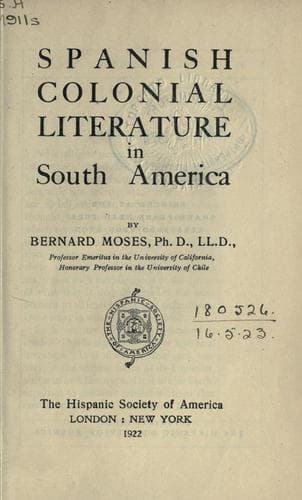
Spanish colonial literature in South AmericaMoses, Bernard
History
Spanish colonial literature in South America
Moses, Bernard
Spanish American literature -- History and criticism
In _La Araucana_ by Ercilla the theme is no longer the ancient Peruvian
state, described by Cieza de León, Garcilaso de la Vega, and Sarmiento,
with its autocratic rulers and submissive subjects, but the plains and
forests of Chile and the Spaniards in conflict with a people who boasted
they had never had a king and had never been subdued, a people sustained
by primitive agriculture and proud of their rigid individualism. The time
represented by the poem is the period following the death of Valdivia,
who had taken possession of that region after the fruitless expedition
of Almagro. Provision had been made that in case of Valdivia’s sudden
death his authority should pass to Jerónimo de Alderete, but if Alderete
had already died, Francisco de Aguirre and Francisco de Villagra in
this order might claim the succession. At the time of Valdivia’s death
Alderete was in Europe, Aguirre in Tucumán, where he had been the
governor of the province for a year and a half, and Villagra was in
Chile. In the absence of Alderete both Aguirre and Villagra were urged
by their respective friends to assume the duties of the vacant office.
The death of Alderete at Panama left Aguirre as the legitimate claimant,
but Villagra’s presence in Chile gave him a practical advantage in the
contest. This dispute and a natural desire to promote the interests of
his family induced Andrés Hurtado de Mendoza, the viceroy of Peru, to set
aside the pretensions of both Aguirre and Villagra, and to appoint his
son, García Hurtado de Mendoza, to be the governor of Chile.
[Illustration: Title Page of the First Edition of “La Araucana”]
[Sidenote: Ercilla’s family]
Alonso de Ercilla y Zúñiga was a member of the expedition sent by the
viceroy to establish García de Mendoza in his office, and to carry on
the war against the Araucanian Indians. He was born in Madrid on August
7, 1533. He was the youngest of the children of Dr. Fortún García
de Ercilla and his wife Leonor de Zúñiga. His father was a famous
jurisconsult, whose writings were read and commented upon in all the
schools of Europe.[56]
[Sidenote: Ercilla’s journeys]
Public-domain text, read in full here on John Shaqi.
Reviews
Reviews
No reviews yet
Be the first to share your thoughts on this work.
Elsewhere in the archive
Join the Discussion
Join the discussion
Sign in to leave a comment or review.
Sign InorCreate an account