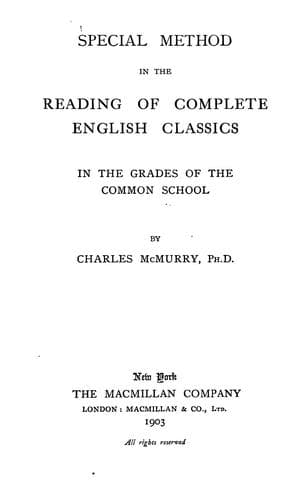
Special Method in the Reading of Complete English Classics: In the Grades of the Common SchoolMcMurry, Charles A. (Charles Alexander)
General
Special Method in the Reading of Complete English Classics: In the Grades of the Common School
McMurry, Charles A. (Charles Alexander)
American literature -- Study and teaching; English literature -- Study and teaching
Suppose now that a wise selection of the best products for school use
had been made. The books for each grade would respond not only to the
ability but to the characteristic temper and mental status of children
at that age. The books would arouse the full compass of the children's
mental power, their emotional as well as intellectual capacities, their
sympathy, interest, and feeling. The teacher who is about to undertake
the training of these children may not know much about children of that
age. How can she best put herself into an attitude by which she can meet
and understand the children on their own ground? Not simply their
intellectual ability and standing, but, better still, their impulses and
sympathies, their motives and hearts? Most people, as they reach
maturity and advance in years, have a tendency to grow away from their
childhood. Their purposes have changed from those of childhood to those
of mature life. They are no longer interested in the things that
interest children. Such things seem trivial and even incomprehensible to
them.
Now the person who is preparing to be a teacher should grow back into
his childhood. Without losing the dignity or purpose of mature life, he
should allow the memories and sympathies of childhood to revive. The
insight which comes from companionship and sympathy with children he
needs in order to guide them with tact and wisdom.
The literature which belongs to any age of childhood is perhaps the best
key to the spirit and disposition of that period. The fact that it is of
permanent worth makes it a fit instrument with which the teacher may
reawaken the dormant experiences and memories of that period in his own
life. The teacher who finds it impossible to reawaken his interest in
the literature that goes home to the hearts of children has _prima
facie_ evidence that he is not qualified to stimulate and guide their
mental movements. The human element in letters is the source of its deep
and lasting power; the human element in children is the centre of their
educative life, and he who disregards this and thinks only of
intellectual exercises is a poor machine. The literature which children
appreciate and love is the key to their soul life. It has power to
stimulate teacher and pupil alike, and is therefore a common ground
where they may both stand and look into each other's faces with
sympathy.
Public-domain text, read in full here on John Shaqi.
Reviews
Reviews
No reviews yet
Be the first to share your thoughts on this work.
Elsewhere in the archive
Join the Discussion
Join the discussion
Sign in to leave a comment or review.
Sign InorCreate an account