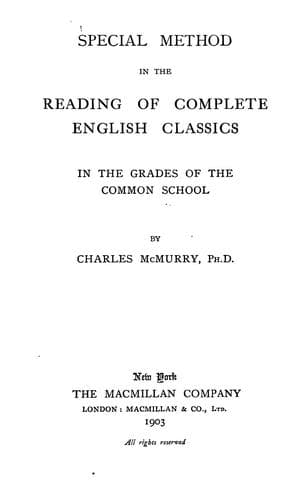
Special Method in the Reading of Complete English Classics: In the Grades of the Common SchoolMcMurry, Charles A. (Charles Alexander)
General
Special Method in the Reading of Complete English Classics: In the Grades of the Common School
McMurry, Charles A. (Charles Alexander)
American literature -- Study and teaching; English literature -- Study and teaching
The third series consists of books for teachers, including great works
of literature, history, and science, which will enrich the teacher's
knowledge and contribute to a broader enthusiasm and culture. The
writings of some of the great essayists, as Ruskin, Carlyle, Emerson,
Kingsley, Motley, Lowell, Huxley, Macaulay, and others, are peculiarly
fit to broaden the teacher's horizon and ennoble his purpose. Some of
the best poems and novels suitable for advanced study are mentioned.
There are also books which deal in a comprehensive and critical, but
sympathetic, way with important literary topics, as the myths and great
epics, the age of chivalry, and the lives of the most eminent writers.
Some of the best works of biography and history are also suggested for
teachers, and a number of the best professional and pedagogical books
for teachers, dealing with literature, reading, and child study.
2. This list of books is of course tentative. There are other literary
works as good, perhaps, but not a few difficulties stand in the way of
the best selection. A few of the best materials are scattered in books
not available for school purposes. Some of the finest of our longer
classics have not been tested much in school use. There is, however, an
abundance of choice English works, complete, well printed and bound, in
cheap, schoolbook form. The chief difficulty, after all, is in selecting
and arranging the best of an abundant and varied collection of excellent
literature. This inspiring problem lies but partly solved at the
threshold of every teacher's work. It requires extensive knowledge of
literature and experience in its use in classes. A masterpiece may be
read in several grades, and teachers will differ in judging its true
place. Schools and classes differ also in their capacity and previous
preparation for classic readings, so that no course of reading will fit
all schools, or, perhaps, any two schools. Many principals will prefer
to use the books one or two grades lower, or higher, than here
indicated. Every teacher should use such a list according to his best
individual judgment as based upon the needs of his school. This list was
discussed and partly made out in conference with a number of experienced
superintendents, and much variety of opinion was expressed as to the
best grade for the use of a number of the selections.
Public-domain text, read in full here on John Shaqi.
Reviews
Reviews
No reviews yet
Be the first to share your thoughts on this work.
Elsewhere in the archive
Join the Discussion
Join the discussion
Sign in to leave a comment or review.
Sign InorCreate an account