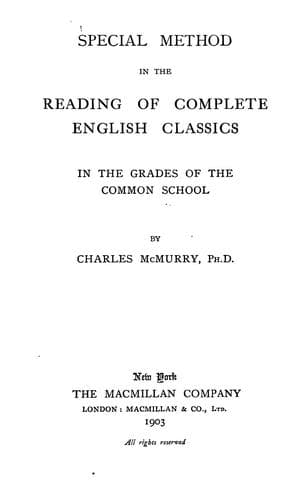
Special Method in the Reading of Complete English Classics: In the Grades of the Common SchoolMcMurry, Charles A. (Charles Alexander)
General
Special Method in the Reading of Complete English Classics: In the Grades of the Common School
McMurry, Charles A. (Charles Alexander)
American literature -- Study and teaching; English literature -- Study and teaching
11. There are certain peculiar difficulties connected with the reading
of longer classics which are much less frequently met with in the usual
school readers. These difficulties are of such a real and serious kind
that many teachers are apt to be discouraged before success is attained.
Complete classics like Webster's speeches, "Julius Cæsar," "Snow-Bound,"
"Marmion," and "Evangeline" have been regarded as too long and difficult
for school purposes. We have found, however, that the greater length,
if rightly utilized, only intensifies the effect of a masterpiece. The
chief objection is the greater language difficulty (hard and unusual
words, proper names, etc.) of the longer classics. This is a real
obstacle and must be fairly met. It is impossible to grade down the
language and thought of a great writer. It is necessary to bring the
class up to his level rather than bring him down to theirs. This
requires time and skill and perseverance on the teacher's part, and
labor and thought in the children. It may require a week or a month to
get a class well under way in "Lady of the Lake," "King of the Golden
River," or the "Sketch-Book." But when well done it is a conquest of no
mean importance. The language, style, and characteristics of the author
are strange and difficult. The scales must drop from children's eyes
before they will appreciate Ruskin or Tennyson or Emerson. The wings of
fancy, the æsthetic sense, do not unfold in a single day. But if these
initial difficulties can be overcome, we shall emerge soon into the
sunlight of interest and success. It takes a degree of faith in good
things and patience under difficulties to attain success in classic
readings. Even when the teacher thinks he is doing fairly well, the
parents sometimes say the work is too hard and the verbal difficulties
too great. Generally, however, parents are satisfied when children work
hard and are interested.
Again, children whose reading in the lower grades has been of the
information order lack the imaginative power that is essential to the
grasp and enjoyment of any masterpiece. The sleeping or dulled fancy
must be awakened. The power to image things, so natural to the poet,
must be aroused and exercised. The lack of training in vivid and poetic
thought in early years is sure to make itself felt in deficient and
languid thought and feeling in the higher grades. But we cannot afford
to give up the struggle. We may be forced to begin lower down in the
series of books, but anything less than a classic is not fit for the
children.
Public-domain text, read in full here on John Shaqi.
Reviews
Reviews
No reviews yet
Be the first to share your thoughts on this work.
Elsewhere in the archive
Join the Discussion
Join the discussion
Sign in to leave a comment or review.
Sign InorCreate an account