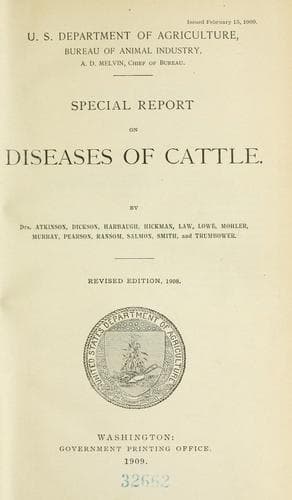
Special report on diseases of cattleUnited States. Bureau of Animal Industry
Science
Special report on diseases of cattle
United States. Bureau of Animal Industry
Cattle -- Diseases
There is a form of congestive apoplexy affecting cattle which are in a
plethoric condition. The congestion, or overfilling with blood, causes
pressure on the brain substance and disorganizes its function. It occurs
mostly in hot weather. In this disease the symptoms are somewhat similar to
those exhibited when the animal has encephalitis, but the onset is more
sudden, the duration is shorter, and there is less fever. There may be
frenzy or coma, or alternations one with the other. The intelligence is
diminished, staring eyes, bracing with the legs, pressing against the stall
partition or manger, red mucous membranes. This condition usually
terminates in recovery.
In such cases bleeding should be resorted to immediately, and when the
power of swallowing is not lost purgatives should be administered. Cold
applications to the head and the general treatment recommended for
encephalitis are indicated.
CONCUSSION OF THE BRAIN.
Severe blows on the head, striking the head against some hard object while
running, or falling on the head may cause concussion of the brain. The
injury may fracture bones of the cranium and produce compression of the
brain.
_Symptoms and treatment._--The symptoms and the treatment that is indicated
differ very little from what has been said under congestion of the brain
and under encephalitis. In some cases it may be necessary to operate to
remove a piece of bone that is pressing on the brain or to remove a clot of
blood under the area which received the blow.
EPILEPSY.
This affection is characterized by the occurrence of sudden convulsions.
The animal may appear to be in a fair state of health usually, but at any
time, in the stable or in the field, it may have a convulsion in which it
will fall and lose consciousness. Epilepsy must not be confounded with
vertigo--the fainting which is an effect of heart troubles.
The exact cause of epilepsy in the majority of cases is unknown.
Post-mortem examinations in many instances have failed to discover any
lesion in connection with the brain or nervous system, while in other
instances disease of the brain has been found in the form of thickening
of the membranes, abscesses, and tumors, and in some cases the affection
has been manifested in connection with a diseased condition of the blood.
The cause has also been traced to reflex irritation, due to teething,
worms, and chronic indigestion.
Public-domain text, read in full here on John Shaqi.
Reviews
Reviews
No reviews yet
Be the first to share your thoughts on this work.
Elsewhere in the archive
Join the Discussion
Join the discussion
Sign in to leave a comment or review.
Sign InorCreate an account