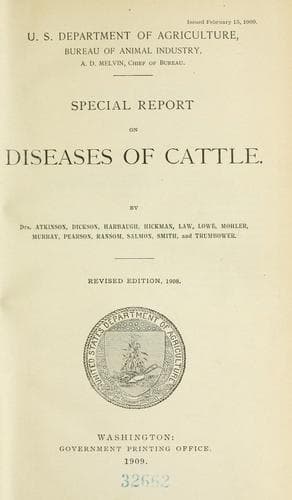
Special report on diseases of cattleUnited States. Bureau of Animal Industry
Science
Special report on diseases of cattle
United States. Bureau of Animal Industry
Cattle -- Diseases
_Treatment._--At first, when not very serious, removal to a quiet,
sheltered place, with a few days on a reduced diet, is all that need be
done. When the animal has fallen, apply cold water or ice to the head; rub
the body and limbs with cloths or wisps of straw and continue the rubbing
for a considerable time. If the power of swallowing is not lost (which may
be ascertained by pouring a little cold water into the mouth), give 3 drams
of stronger liquor ammonia, diluted with a quart of cold water. Be very
careful in drenching the animal when lying down. Repeat the drench in a
half hour and an hour after the first one has been given. Instead of the
ammonia, a drench composed of 3 ounces of spirits of nitrous ether in a
pint of water may be given, if more convenient, but the ammonia drench is
preferable. If unconsciousness continues, so that a drench can not be
administered, the same quantity of ammonia and water may be injected with a
syringe into the rectum. The popular aqua ammonia, commonly called
"hartshorn," will do as well as the stronger liquor ammonia, but as it is
weaker than the latter the dose for a cow is about 1-1/2 ounces, which
should be diluted with a quart of water before it is given to the animal,
either as a drench or an enema. When ammonia can not be obtained, an ounce
of tincture of digitalis may be given.
As soon as the animal is able to rise it should be assisted and moved to
the nearest shelter. All the cold water it will drink should be allowed.
The ammonia or spirits of nitrous ether drench should be administered every
three hours so long as there is much failure of strength. The diet should
be limited for several days--bran slops and a little grass. When signs of
returning strength are presented, 12 ounces of Epsom salt dissolved in a
quart of warm water may be given in those cases which have been down and
unconscious, but do not give it while much weakness remains, which may be
for several days after the attack. The flesh of an animal that is suffering
from heat stroke should not be prepared for use as food. On account of the
fever with which the animal suffers, the flesh contains toxins that may
render it poisonous to the consumer.
INJURIES TO THE SPINAL CORD.
Public-domain text, read in full here on John Shaqi.
Reviews
Reviews
No reviews yet
Be the first to share your thoughts on this work.
Elsewhere in the archive
Join the Discussion
Join the discussion
Sign in to leave a comment or review.
Sign InorCreate an account