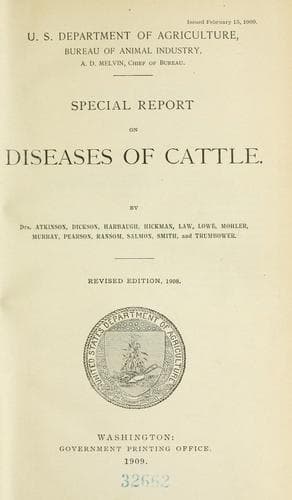
Special report on diseases of cattleUnited States. Bureau of Animal Industry
Science
Special report on diseases of cattle
United States. Bureau of Animal Industry
Cattle -- Diseases
10 wheat | | | | | | | | | |
straw, 10 |119.00|23.20|1,038| 7.74| 0.21| 4.06| 1.91| 1.69|15.4 |0.8
clover hay, | | | | | | | | | |
11.7 bean | | | | | | | | | |
meal, 2.8 | | | | | | | | | |
starch, and | | | | | | | | | |
0.5 rape oil | | | | | | | | | |
| | | | | | | | | |
17.86 bean | | | | | | | | | |
straw, and | 54.84|12.60|1,043| 7.06| 0.40| 2.53| 1.21| 1.15| 5.3 |0.83
1.6 bean meal | | | | | | | | | |
| | | | | | | | | |
14.88 bean | | | | | | | | | |
straw | 55.76|16.34|1,036| 5.45| 0.11| 1.41| 0.67| 0.64| 3.83|0.3
| | | | | | | | | |
16.90 meadow | | | | | | | | | |
hay | 36.26|15.14|1,042| 7.91| 1.30| 1.73| 0.91| 0.92| 4.37|3.3
--------------+------+-----+-----+-----+-----+-----+-----+-----+-----+-----
The varying quantity of urea (from 1.6 to 15.4 ounces) is most suggestive
as to the action of the more or less nitrogenous feed and the resulting
concentration of the urine and blood. Hippuric acid, on the other hand, is
most abundant when the animal is fed on hay and straw.
The specific gravity of the urine of cattle varies from 1,030 to 1,060 in
health, water being 1,000. It is transparent, with a yellowish tinge, and
has a characteristic, musky smell. The chemical reaction is alkaline,
turning red litmus paper blue. The quantity passed in twenty-four hours
varies greatly, increasing not only with the water drunk, but with the
albuminoids taken in with the feed and the urea produced. If a solution of
urea is injected into the veins the secretion of urine is greatly
augmented. Similarly the excess of salts like carbonate of potash in the
feed, or of sugar, increases the action of the kidneys. Only about 20 per
cent of the water swallowed escapes in the urine, the remaining 80 per cent
passing mostly from the lungs, and to a slight extent by the bowels. The
skin of the ox does not perspire so readily nor so freely as that of the
horse; hence the kidneys and lungs are called upon for extra work. The
influence of an excess of water in the feed is most remarkable in swill-fed
distillery cattle, which urinate profusely and frequently, yet thrive and
fatten rapidly.
Public-domain text, read in full here on John Shaqi.
Reviews
Reviews
No reviews yet
Be the first to share your thoughts on this work.
Elsewhere in the archive
Join the Discussion
Join the discussion
Sign in to leave a comment or review.
Sign InorCreate an account