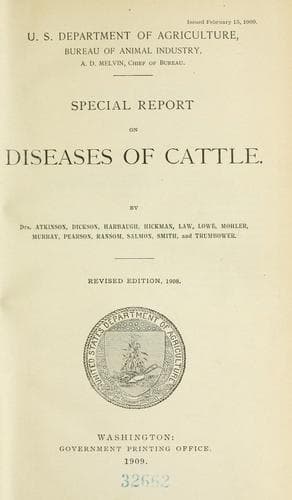
Special report on diseases of cattleUnited States. Bureau of Animal Industry
Science
Special report on diseases of cattle
United States. Bureau of Animal Industry
Cattle -- Diseases
other impervious soils, and the occurrence of bloody urine in the advanced
stages of several contagious diseases. Some mineral poisons--such as iodin,
arsenic, and phosphorus taken to excess--may cause hematuria, and finally
the symptoms may be merely the result of a constitutional predisposition of
the individual or family to bleeding. In some predisposed subjects,
exposure of the body to cold or wet will cause the affection.
The specific symptom of bloody or smoky water is a very patent one. It may
or may not be associated with fever, with the presence or absence of
abdominal tenderness on pressure, with a very frothy state of the milk or
even a reddish tinge, with or without marked paleness of the mucous
membranes, and general weakness. When direct injury to the kidneys is the
immediate cause of the disease the urine will be passed often, in small
quantity at a time, and with much straining. When there is bloodlessness (a
watery blood) from insufficient nourishment, fever is absent and the red
water is at first the only symptom. When the active cause has been irritant
plants, abdominal tenderness, colics, and other signs of bowel inflammation
are marked features.
_Treatment._--Treatment varies according as the cause has been a direct
irritant operating on a subject in vigorous health or a microbian poison
acting on an animal deficient in blood and vigor. In the first form of red
water a smart purgative (1 pound to 1-1/2 pounds Glauber's salt) will clear
away the irritants from the bowels and allay the coexistent high fever. It
will also serve to divert to the bowels much of the irritant products
already absorbed into the blood and will thus protect the kidneys. In many
such cases a liberal supply of wholesome, easily digestible feed will be
all the additional treatment required. In this connection demulcent feed
(boiled flaxseed, wheat bran) is especially good. If much blood has been
lost, bitters (gentian, one-half ounce) and iron (sulphate of iron, 2
drams) should be given for a week.
For cases in which excess of diuretic plants has been taken, it may be well
to replace the salts by 1 to 2 pints of olive oil, adding 1 ounce of
laudanum and 2 drams of gum camphor; also to apply fomentations or a fresh
sheepskin over the loins. Buttermilk or vinegar, one-half pint, or
sulphuric acid, 60 drops in a pint of water, may also be used frequently as
injections. In cases caused by sprained or fractured loins, inflamed
kidneys, stone or gravel, the treatment will be as for the particular
disease in question.
Public-domain text, read in full here on John Shaqi.
Reviews
Reviews
No reviews yet
Be the first to share your thoughts on this work.
Elsewhere in the archive
Join the Discussion
Join the discussion
Sign in to leave a comment or review.
Sign InorCreate an account