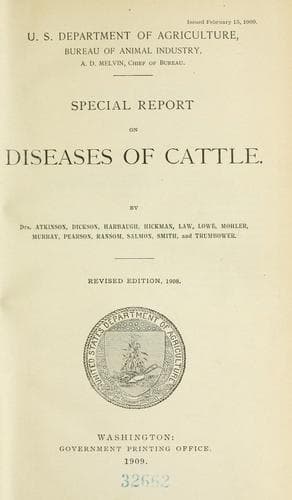
Special report on diseases of cattleUnited States. Bureau of Animal Industry
Science
Special report on diseases of cattle
United States. Bureau of Animal Industry
Cattle -- Diseases
In the chronic forms of kidney inflammation the same protection against
cold and similar general treatment are demanded. Tonics, however, are
important to improve the general health (phosphate of iron, 2 drams;
powdered nux vomica, 20 grains; powdered gentian root, 4 drams, daily). In
some instances the mineral acids (nitric acid, 60 drops, or
nitrohydrochloric acid, 60 drops, daily) may be used with the bitters.
Mustard applied to the loins in the form of a thin pulp made with water and
covered for an hour with paper or other impervious envelope, or water
hotter than the hand can bear, or cupping, may be resorted to as a
counterirritant. In cupping, shave the loins, smear them with lard, then
take a narrow-mouthed glass, expand the air within by smearing its interior
with a few drops of alcohol, setting it on fire and instantly pressing the
mouth of the vessel to the oiled portion of the skin. As the air within the
vessel cools it contracts, tending to form a partial vacuum, and the skin,
charged with blood, is strongly drawn up within it. Several of these being
applied at once, a strong derivation from the affected kidneys is obtained.
In no case of inflamed or irritable kidney should Spanish flies or oil of
turpentine be used upon the skin.
PARASITES OF THE KIDNEY.
As the kidney is the visual channel by which the bacteria leave the system,
this organ is liable to be implicated when microphytes exist in the blood,
and congestions and blood extravasions are produced. In anthrax, southern
cattle fever (Texas fever), and other such affections bloody urine is the
consequence. Of the larger parasites attacking the kidney may be specially
named the cystic form of the echinococcus tapeworm of the dog, the cystic
form of the unarmed or beef tapeworm of man, the diving bladderworm--the
cystic form of the marginate tapeworm of the dog, and the giant strongyle--
the largest of the roundworms. These give rise to general symptoms of
kidney disease, but the true source of the trouble is likely to be detected
only if the heads or hooklets of the tapeworm or the eggs of the roundworm
are found on microscopical examination of the urine.
TUMORS OF THE KIDNEY (HYPERTROPHY OR ATROPHY).
The kidney may be the seat of cancerous or simple tumors, and it may be
unnaturally enlarged or reduced in size, but though there may be signs of
urinary disorder the true nature of the disease is seldom manifest until
after death. The passing of blood and of large multi-nucleated cells in
the urine (to be detected under the microscope) may betray the existence of
an ulcerated cancer of the kidney. The presence of cancerous enlargement of
(superficial) lymphatic glands may further assist and confirm the decision.
RETENTION OF URINE.
Public-domain text, read in full here on John Shaqi.
Reviews
Reviews
No reviews yet
Be the first to share your thoughts on this work.
Elsewhere in the archive
Join the Discussion
Join the discussion
Sign in to leave a comment or review.
Sign InorCreate an account