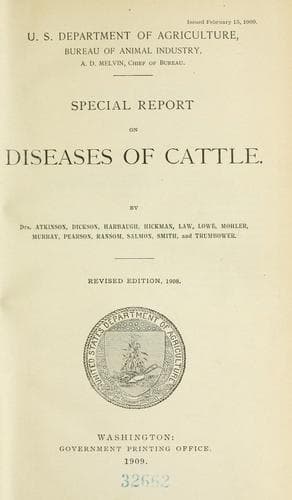
Special report on diseases of cattleUnited States. Bureau of Animal Industry
Science
Special report on diseases of cattle
United States. Bureau of Animal Industry
Cattle -- Diseases
The questions as to whether a bull is a sure stock getter and whether a cow
is a breeder are so important that it would be wrong to pass over other
prominent causes of sterility. Breeding at too early an age is a common
source of increasing weakness of constitution which has existed in certain
breeds. Jerseys have especially been made the victims of this mistake, the
object being to establish the highest milking powers in the smallest
obtainable body which will demand the least material and outlay for its
constant repair of waste. With success in this line there has been the
counterbalancing disadvantage of impaired vigor, with too often lessened
fertility as well as increased predisposition to disease. When the heifers
of the race have for generation after generation been bred under a year
old, the demand for the nourishment of the fetus is too great a drain on
the immature animal, which accordingly remains small and stunted. As it
fails to develop in size, so every organ fails to be nourished to
perfection. Similarly with the immature bull put to too many cows; he fails
to develop his full size, vigor, or stamina, and transfers his acquired
weakness to his progeny. An increasing number of barren females and an
increasing proclivity to abortions are the necessary results of both
courses. When this early breeding has occurred accidentally it is well to
dry up the dam just after calving, and to avoid having her served again
until full grown.
Some highly fed and plethoric females seem to escape conception by the very
intensity of the generative ardor. The frequent passage of urine,
accompanied by contractions of the womb and vagina and a profuse secretion
from their surfaces, leads to the expulsion of the semen after it has been
lodged in the genital passages. This may be remedied somewhat by giving
1-1/2 pounds of Epsom salt a day or two before she comes in heat, and
subjecting her at the same time to a spare diet. Should the excessive ardor
of the cow not be controllable in this way, she may be shut up for a day or
two, until the heat is passing off, when under the lessened excitement the
semen is more likely to be retained.
The various diseases of the ovaries, their tubes, the womb, the testicles
and their excretory ducts, as referred to under "Excess of venereal
desire," are causes of barrenness. In this connection it may be said that
the discharges consequent on calving are fatal to the vitality of semen
introduced before these have ceased to flow; hence service too soon after
calving, or that of a cow which has had the womb or genital passages
injured so as to keep up a mucopurulent flow until the animal comes in
heat, is liable to fail of conception. Any such discharge should be first
arrested by repeated injections as for leucorrhea, after which the male may
be admitted.
Public-domain text, read in full here on John Shaqi.
Reviews
Reviews
No reviews yet
Be the first to share your thoughts on this work.
Elsewhere in the archive
Join the Discussion
Join the discussion
Sign in to leave a comment or review.
Sign InorCreate an account