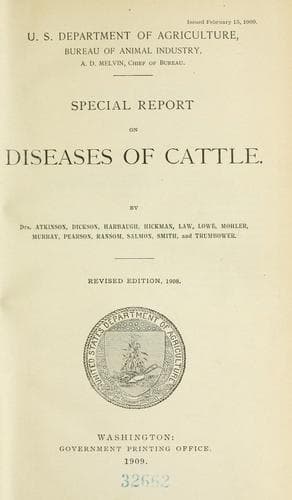
Special report on diseases of cattleUnited States. Bureau of Animal Industry
Science
Special report on diseases of cattle
United States. Bureau of Animal Industry
Cattle -- Diseases
In case the disease has progressed to absolute obstruction, with the
bladder ready to rupture any moment, no time must be lost in opening into
the urethra with a sharp knife over the bony arch under the anus, where the
pulsations are seen in urinating. This incision is best made in the median
line from above downward, but in the absence of a skillful operator a
transverse incision with a sharp knife over the bone in the median line
until the urine flows with a gush is better than to let the patient die.
Considerable blood will be lost and the wound will heal tardily, but the ox
will be preserved. Then the slitting and cleansing of the sheath can be
done at leisure, as described above. If the bladder is ruptured, the case
is hopeless.
INFLAMMATION OF THE SHEATH AND PENIS FROM BRUISING.
This also is an affection of work oxen, caused by the pressure and friction
of the sling when the animals are held in stocks for shoeing. This crushing
of both sheath and penis for half an hour or more leads to the development,
some hours later, of a hard, hot, and painful swelling, extending from the
scrotum as far as the opening of the sheath. Fever sets in, with dry
muzzle, red eyes, hard, full, rapid pulse, accelerated breathing, and
elevated temperature. The ox stands obstinately with his hind legs drawn
apart and urine falling drop by drop from the sheath. Appetite and
rumination are suspended. In twenty-four hours there may be indications of
advancing gangrene (mortification), the swelling becomes cold, soft, and
doughy; it may even crack slightly from the presence of gas; a reddish
brown, fetid liquid oozes from the swelling, especially around the edges,
and if the animal survives it is only with a great loss of substance of the
sheath and penis.
_Prevention._--The prevention of such an injury is easy. It is only
necessary to see that the slings do not press upon the posterior part of
the abdomen. They must be kept in front of the sheath.
_Treatment._--Treatment, to be effective, must be prompt and judicious. Put
around the patient a strap with soft pads in contact with the affected
parts, constantly soaked in cold water for at least 24 hours. A pound or
two of Epsom salt in 4 quarts of hot water should also be given. The second
day the parts may be washed with 1 quart of witch-hazel (extract), 2 drams
sugar of lead, and 1 ounce laudanum, or the cold-water irrigations may be
continued if the active inflammation persists. In case the swelling
continues hard and resistant, it may be pricked at the most prominent
points to the depth of one-third of an inch with a lancet first dipped in
dilute carbolic acid, and the whole surface should be washed frequently
with some antiseptic solution.
When softening occurs in the center of a hard mass and fluctuation can be
felt between two fingers pressed on different parts of such softening, it
should be freely opened to let out the putrid pus, and the cavity should be
syringed often with antiseptic solution.
Public-domain text, read in full here on John Shaqi.
Reviews
Reviews
No reviews yet
Be the first to share your thoughts on this work.
Elsewhere in the archive
Join the Discussion
Join the discussion
Sign in to leave a comment or review.
Sign InorCreate an account