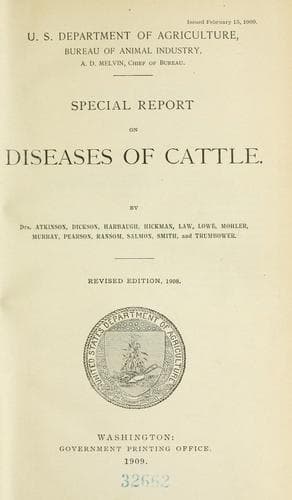
Special report on diseases of cattleUnited States. Bureau of Animal Industry
Science
Special report on diseases of cattle
United States. Bureau of Animal Industry
Cattle -- Diseases
_Treatment._--A lotion of a dram of alum in a quart of water may be applied
(injected into the sheath, if necessary), and a large sponge constantly
irrigated by a stream of cold water may be kept applied by means of a
surcingle to the outer side of the sheath. Incisions are rarely applicable
to an organ of this kind, but in case of the existence of an extensive clot
which is unlikely to be absorbed the lancet may be resorted to. If the
injury leads to paralysis of the penis and hanging out of its sheath, it
should be supported in a sling and astringents used freely until
inflammation subsides. Then the restoration of power may be sought by a
blister between the thighs, by the use of electricity, or by the careful
use of nerve stimulants, such as strychnin, 1 grain twice daily.
ULCERS ON THE PENIS.
Sores on the penis of the bull may result from gravel or sebaceous masses
in the sheath or from having served a cow having leucorrhea.
_Treatment._--These may be treated by frequent injections into the sheath
of a lotion made with 1 dram sugar of lead, 60 drops carbolic acid, and 1
quart water.
POLYPUS OF THE VAGINA OR UTERUS.
A polypus is a tumor growing from the mucous membrane, and often connected
to it by a narrow neck. A definite cause can not always be assigned. If
growing in the vagina, a polypus may project as a reddish, rounded tumor
from the vulva, especially during the act of passing water. It can be
distinguished from descent of the womb by the absence of the orifice of
that cavity, which can be felt by the oiled hand beyond the tumor in the
depth of the vagina. From a vaginal hernia caused by the protrusion of some
abdominal organ enveloped by the relaxed wall of the vagina it may be
distinguished by its persistence, its firm substance, and the impossibility
of returning it into the abdomen by pressure. A hernia containing a portion
of bowel gurgles when handled and can be completely effaced by pressure,
the gut passing into the abdomen.
A polypus in the womb is less easily recognized. At the time of calving it
may be felt through the open mouth of the womb and recognized by the
educated touch (it must be carefully distinguished from the mushroom-formed
cotyledons (Pl. XIII, fig. 2), to which in ruminants the fetal membranes
are attached). At other times, unless the womb is opened in the effort to
expel it, the polypus can be detected only by examining the womb with the
oiled hand introduced through the rectum.
Public-domain text, read in full here on John Shaqi.
Reviews
Reviews
No reviews yet
Be the first to share your thoughts on this work.
Elsewhere in the archive
Join the Discussion
Join the discussion
Sign in to leave a comment or review.
Sign InorCreate an account