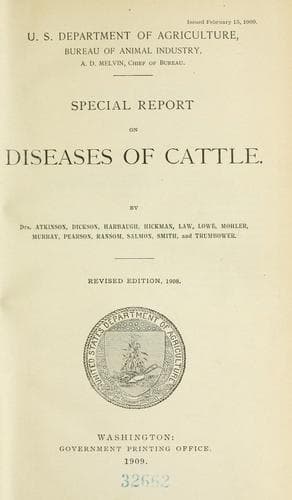
Special report on diseases of cattleUnited States. Bureau of Animal Industry
Science
Special report on diseases of cattle
United States. Bureau of Animal Industry
Cattle -- Diseases
During pregnancy this is common from chronic relaxation of the vaginal
walls and from lying in stalls that are lower behind than in front. The
protrusion is of a rounded form and smooth, and if it embraces both sides
of the canal it is double, with a passage between. It may sometimes be
remedied by raising the hind part of the stall higher than the front part.
This failing, a truss may be applied as for eversion of the womb, and worn
until the period of calving approaches. (Pls. XXII, XXIII.)
HERNIA (BREACH) OF THE UTERUS.
In advanced pregnancy this occurs usually from a gradual relaxation and
distention of the lower wall of the abdomen in the region of the udder, so
that the latter is displaced downward, and in the sac above and in front of
it may be felt the form and movements of the fetus. In other cases the womb
escapes through a great laceration of the abdominal muscles to one side of
the udder, and the hernial mass extends down to one side of that organ.
However unsightly, this often allows the animal to complete its pregnancy
naturally, and a broad, supporting bandage placed around the abdomen is
about all that can be recommended. After calving it is best to fatten the
cow.
CRAMPS OF THE HIND LIMBS.
The compression of the nerves by the womb and fetus passing through the
pelvis sometimes causes cramp and inability to move the limb, but it
disappears under friction and motion and is never seen after calving.
DROPSY OF THE HIND LIMBS AND BETWEEN THE THIGHS.
In the latter months of pregnancy the hind legs may swell beneath the
hocks, or a soft swelling which pits on pressure with the finger appears
from the vulva down between the thighs to the udder and in front. It is
mainly ascribable to the pressure of the enlarged womb on the blood
vessels, is not dangerous, and disappears after calving.
DROPSY OF THE MEMBRANES OF THE FETUS (DROPSY OF THE WOMB).
The unimpregnated womb may be filled with a dropsical fluid, but the
pregnant womb is more liable to become overdistended by an excess of fluid
in the inner water bag in which the fetus floats. (Pl. XII.) From an
unhealthy state of this membrane or of blood of the fetus (water blood)
this liquid may go on accumulating until the cow seems almost as broad as
she is long. If the trouble has not originated in the ill health of the
cow, the result is still to draw on her system, overtax her strength, and
derange her digestion, so that the result may prove fatal to both mother
and offspring. On the other hand, I have known extreme cases that came to
the natural term without help and produced a living calf, after which the
dam did well. The natural resort is to draw off a portion of the fluid
through a hollow needle passed through the neck of the womb or through its
tense wall adjacent. This may be repeated several times, as demanded, to
relieve the cow from the injurious distention.
PARALYSIS OF THE HIND PARTS.
Public-domain text, read in full here on John Shaqi.
Reviews
Reviews
No reviews yet
Be the first to share your thoughts on this work.
Elsewhere in the archive
Join the Discussion
Join the discussion
Sign in to leave a comment or review.
Sign InorCreate an account