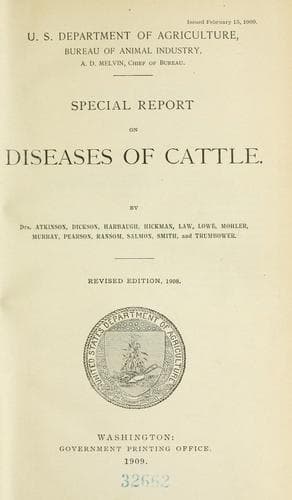
Special report on diseases of cattleUnited States. Bureau of Animal Industry
Science
Special report on diseases of cattle
United States. Bureau of Animal Industry
Cattle -- Diseases
_History._--This disease has been known in England and continental Europe
for many years, and descriptions of it are mentioned in the writings of
Mascal, Lafoose, Skellet, Lawrence, St. Cyr, Z¸ndel, and Youatt. In the
early part of the eighteenth century British veterinarians recognized its
contagiousness, but it remained for Franck (1876), Lehnert (1878), and
Br‰uer (1880) to produce the disease in healthy, pregnant cows by the
introduction of exudate and material from aborting animals. Nocard (1888)
isolated from the exudate between the mucous membrane of the uterus and
fetal membranes a micrococcus and a short bacillus which were found
continually in contagious abortion, but he failed to reproduce the disease
by inoculations of pure cultures of these organisms into healthy, pregnant
animals. In 1897 Bang, assisted by Stribolt, published their findings
regarding infectious abortion of cattle, in which they incriminated Bang's
bacillus of abortion as the causative agent. With pure cultures of this
bacillus they were able to produce the disease artificially and to recover
the same organism from the experimental cases. Since that time many noted
investigators, both in this country and in Europe, have confirmed these
findings.
_Cause._--The _Bacterium abortus_ of Bang is now generally recognized as
the causative agent of the disease of cattle. Formerly it was thought that
abortion was due to injury, such as blows, horn thrusts, falls, etc., or
the eating of spoiled feed and certain plants, and while this may be true
in a limited number of cases, careful investigations have demonstrated
these claims to be largely unfounded. It is now generally recognized that
when abortion occurs in herds from time to time, it is safe to assume that
the disorder is of an infectious nature and should be so treated.
_Natural mode of infection._--This phase of the disease is of greatest
importance for a clear understanding of the methods of prevention. Many
investigators have demonstrated that the infection is transmitted through
the digestive tract, through contaminated feed and water. The germs are
taken up by the body from the intestines with the liquid nourishment, reach
the blood, and are carried to the genital organs, where they find
conditions best suited to their development. Some assert that calves are
infected in this manner by suckling infected mothers, the germs being
present in the milk, or the teats having been contaminated by coming in
contact with infective discharges. It is claimed that infection contracted
in this manner remains dormant in the body of the calf until pregnancy
begins, and then the organism, finding conditions suitable for its
development, produces the disease.
Public-domain text, read in full here on John Shaqi.
Reviews
Reviews
No reviews yet
Be the first to share your thoughts on this work.
Elsewhere in the archive
Join the Discussion
Join the discussion
Sign in to leave a comment or review.
Sign InorCreate an account