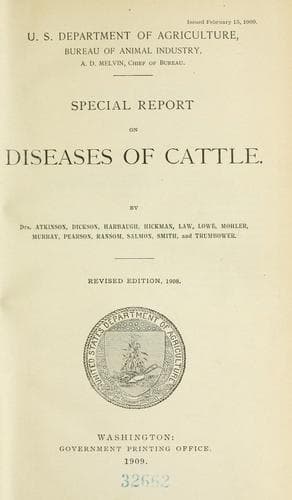
Special report on diseases of cattleUnited States. Bureau of Animal Industry
Science
Special report on diseases of cattle
United States. Bureau of Animal Industry
Cattle -- Diseases
_Lesions._--The most characteristic change is found in the uterus where a
dark-brown fluid, purulent or even gluey in consistency, and containing
grayish-white flakes separates the material membranes from those of the
fetus, preventing that intimate contact between the two which is so
necessary for the interchange of fluids and gases by which the fetus is
nourished and by which it obtains its oxygen. These being cut off, the
fetus must of course die. The germs producing the disease are found in
greatest numbers at this point. In addition there may be inflammatory
changes, first in the walls of the uterus and then in the tissues of the
fetus. These inflammatory changes seem most intense in the cotyledons and
result in the destruction of the minute structure of those bodies, and they
appear swollen, pale, and soft. The membrane of the uterus between the
cotyledons also may show inflamed and necrotic patches.
_Complications._--Serious results sometimes follow abortion, and this is
particularly the case when there is retained afterbirth. The retained
membranes decompose, the poisonous products of decomposition and the
organisms of decomposition themselves are absorbed, blood poisoning
results, and the animal dies. Sometimes, when the animal is able to resist
the effects of this decomposition, the uterus becomes the seat of such
severe changes that sterility results. The walls of that organ become
thickened and hard, the lining membranes become eroded, and conception can
not take place. At other times the ovaries, where the reproductive cells
originate, become affected and lose their function. Abortion does not
invariably follow infection, but the calf is carried to full term. In these
cases, however, retained afterbirth is a common occurrence, even to the
extent that frequent retention of afterbirth in a herd may be taken as an
indication of the presence of the disease. Very often suppurative processes
persist for a long time, preventing conception, or sterility may result
without apparent cause. A sterile cow is valueless, of course, for any
purpose except for beef. Such animals are a source of infection for the
others and should not be allowed to remain in the herd.
Public-domain text, read in full here on John Shaqi.
Reviews
Reviews
No reviews yet
Be the first to share your thoughts on this work.
Elsewhere in the archive
Join the Discussion
Join the discussion
Sign in to leave a comment or review.
Sign InorCreate an account