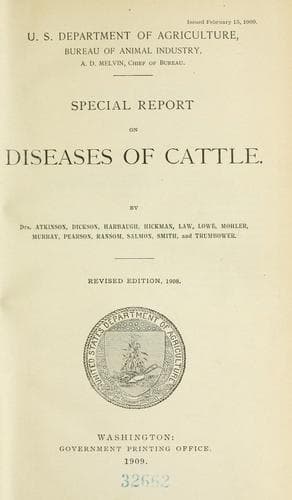
Special report on diseases of cattleUnited States. Bureau of Animal Industry
Science
Special report on diseases of cattle
United States. Bureau of Animal Industry
Cattle -- Diseases
In obstinate cases, in which the hand can be made to pass through the neck
of the womb easily, additional help may be had from the use of the
instrument shown in Plate XX, figure 5. Two cords, with running nooses, are
successively introduced and made fast on two limbs of the calf; the cords
are then passed through the two rings on the end of the instrument, which
is passed into the womb and the cords drawn tight and fixed round the
handle. Then, using the handle as a lever, it is turned in the direction
opposite to the twist. The hand should meanwhile be introduced into the
womb and the snared limbs seized and pressed against its walls so as to
secure the rotation of the uterus along with the body of the fetus. The
relaxation of the constriction and the effacement of the spiral folds will
show when success has been gained, and the different members at one end of
the body should then be brought up so as to secure a natural presentation.
NARROW PELVIS FROM FRACTURE OR DISEASE.
In a small cow the pelvis may be too narrow to pass a calf sired by a bull
of a large breed, but this is exceptional, as the fetus usually
accommodates itself to the size of the dam and makes its extra growth after
birth. When the pelvic bones have been fractured repair takes place with
the formation of a large permanent callus, which, projecting internally,
may be a serious obstacle to calving. Worse still, if the edge of the
broken bone projects internally as a sharp spike or ridge, the vaginal
walls are cut upon it during the passage of the calf, with serious or fatal
result. In other cases, where the cow has suffered from fragility of bone
(fragilitas ossium) the thickening of the bone causes narrowing of the long
passage of the pelvis and the crumbling fractures poorly repaired, with an
excess of brittle new material, may form an insuperable obstacle to
parturition. Cows affected in any of these ways should never again be bred,
but if they do get pregnant and reach full time a careful examination will
be necessary to determine whether natural parturition can take place or if
the calf must be extracted in pieces. (See "Embryotomy," p. 202.)
OBSTRUCTION BY MASSES OF FAT.
This is not unknown in old cows of the beef breeds, the enormous masses of
fat upon and within the pelvis being associated with weakness or fatty
degeneration of the muscles. If the presentation is natural, little more is
wanted than a judicious traction upon the fetus to compress and overcome
the soft resisting masses.
OBSTRUCTION BY A FULL BLADDER OR RECTUM OR BY STONE.
In all cases of delayed or tardy parturition the evacuation of rectum and
bladder is important, and it is no less so in all difficult parturitions.
Stone in the bladder is fortunately rare in the cow, but when present it
should be removed to obviate crushing and perhaps perforation of the organ
during calving.
CALVING RETARDED BY NERVOUSNESS.
Public-domain text, read in full here on John Shaqi.
Reviews
Reviews
No reviews yet
Be the first to share your thoughts on this work.
Elsewhere in the archive
Join the Discussion
Join the discussion
Sign in to leave a comment or review.
Sign InorCreate an account