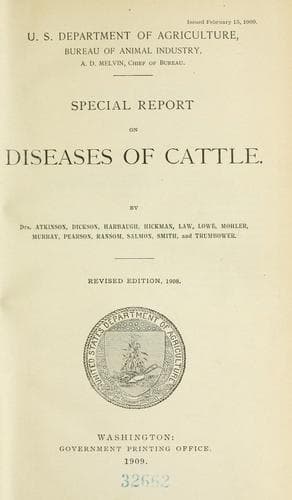
Special report on diseases of cattleUnited States. Bureau of Animal Industry
Science
Special report on diseases of cattle
United States. Bureau of Animal Industry
Cattle -- Diseases
P P {
o r { {Hind limb bent on itself at the hock. Hock and buttocks
s e {Hind Limbs{ present.
t s { {Hind limb bent at the hips. Buttocks present.
e e {
r n {Transverse{Back of calf turned to the right or left side.
i t {
o a {Inverted {Back of calf turned to the floor of the pelvis and udder.
r t {
i {
o {
n {
{Head up toward the spine, croup
{Position of calf vertical { toward udder.
T { { {Head down toward udder, croup
r {Back { { toward spine.
u P {and {
n r {loins { {Head toward the right side,
k e {presented.{Position of calf transverse{ croup toward the left.
s { {
e { { {Head toward the left side,
n { { { croup toward the right.
t { {
a { {
t {Breast { {Head toward right side, croup
i {and {Position of calf transverse{ toward left.
o {abdomen { {Head toward left side, croup
n {presented.{ { toward right.
s {
These include all general presentations, yet other subsidiary ones will at
once occur to the attentive reader. Thus, in each anterior or posterior
presentation, with the back of the calf turned downward or to one side, the
case may be complicated by the bending back of one or more members as a
whole or at the joint just above the shank bones (knee or hock). So also in
such anterior presentation the head may be turned back.
_Head and fore feet presented--Back turned to one side._--The calf has a
greater diameter from above down (spine to breastbone) than it has from
side to side, and the same is true of the passage of the pelvis of the cow,
which measures, on an average, 8-7/10 inches from above downward and 7-9/10
inches from side to side. Hence the calf passes most easily with its back
upward, and when turned with its back to one side calving is always tardy
and may be difficult or impossible. The obvious remedy is to rotate the
calf on its own axis until its spine turns toward the spine of the cow. The
operation is not difficult if the body of the calf is not yet fixed in the
passages. The presenting feet are twisted over each other in the direction
desired, and this is continued until the head and spine have assumed their
proper place. If the body is firmly engaged in the passages the skin of the
whole engaged portion should be freely lubricated with lard, and the limbs
and head twisted over each other as above. The limbs may be twisted by an
assistant when the head is manipulated by the operator, who drags on the
rope turned halfway round the limbs and assists in the rotation with his
other hand in the passages.
Public-domain text, read in full here on John Shaqi.
Reviews
Reviews
No reviews yet
Be the first to share your thoughts on this work.
Elsewhere in the archive
Join the Discussion
Join the discussion
Sign in to leave a comment or review.
Sign InorCreate an account