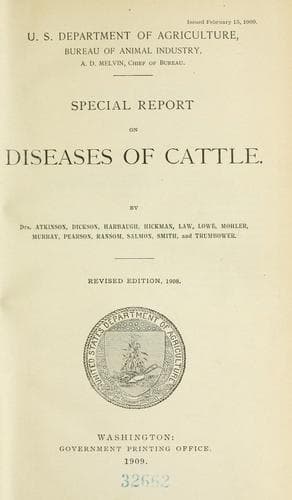
Special report on diseases of cattleUnited States. Bureau of Animal Industry
Science
Special report on diseases of cattle
United States. Bureau of Animal Industry
Cattle -- Diseases
When, however, the shoulders are already engaging in the pelvis the feet
can not thus be lifted up, and to gain room a repeller (Pl. XX, fig. 7)
must be used to push back the body of the calf. This is an instrument with
a long, straight stem, divided at the end into two short branches (2 to 3
inches long) united to the stem by hinges so that they can be brought into
a line with the stem for introduction into the womb and then spread to be
implanted in the breast. In the absence of a repeller a smooth, round, fork
handle may be used, the prongs having been removed from the other end. A
third device is to have an assistant strip his arm to the shoulder and,
standing back to back with the operator, to introduce his right arm into
the passages along with the operator's left (or vice versa) and push back
the body of the calf while the operator seeks to bring up a limb. The
repeller or staff having been planted safely in the breast of the calf, an
assistant pushes upon it in a direction either forward or slightly upward,
so as not only to follow the natural curve of the body and favor its
turning in the line of that curve within the womb, but also to carry the
shoulders upward toward the spine and obtain more room for bringing up the
missing feet. It is good policy, first, to put a halter (Pl. XXI, figs.
4_a_ and 4_b_) on the head or a noose (Pl. XXI, fig. 3) on the lower jaw
and a rope round each limb at the knee, so as to provide against the loss
of any of these parts when the body is pushed back into the womb. This
offers the further advantage that by dragging upon these ropes the body can
be advanced in the passage until the foot is reached, when the rope must be
slackened and the repeller used to get room for bringing up the foot. If
the cow is lying, the operator should first secure the foot on the upper
side and then, if necessary, turn the cow on its opposite side so as to
bring up the other.
In using the instruments some precautions are demanded. They must be
invariably warmed before they are introduced, and they should be smeared
with lard or oil to make them pass easily and without friction. The
assistant who is pushing on the instrument must be warned to stop if at any
time resistance gives way. This may mean the turning of the fetus, in which
case the object of repulsion has been accomplished, but much more probably
it implies the displacement of the instrument from the body of the fetus,
and unguarded pressure may drive it through the walls of the womb.
Public-domain text, read in full here on John Shaqi.
Reviews
Reviews
No reviews yet
Be the first to share your thoughts on this work.
Elsewhere in the archive
Join the Discussion
Join the discussion
Sign in to leave a comment or review.
Sign InorCreate an account