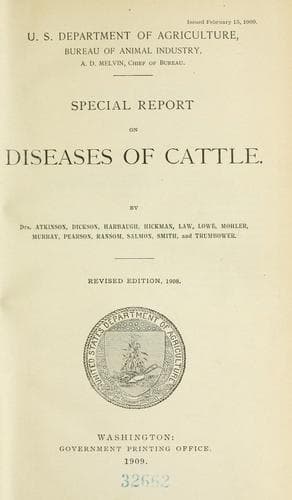
Special report on diseases of cattleUnited States. Bureau of Animal Industry
Science
Special report on diseases of cattle
United States. Bureau of Animal Industry
Cattle -- Diseases
This end is drawn back through the vagina like the
first, and is tied around the other so as to form a running noose. The rope
is now drawn through the ring until it forms a tight loop, encircling the
belly just in front of the hind limbs. On this strong traction can be made
without interfering with the full flexion of the limbs on the body, and if
the case is a suitable one, and the body of the fetus and the passages are
both well lubricated with oil or lard, a successful parturition may be
accomplished. A less desirable method is to put a rope around one thigh or
a rope around each and drag upon these, but manifestly the strain is not so
directly on the spine, and the limbs may be somewhat hampered in flexion.
This method being inapplicable, the next resort is to cut off one or both
hind limbs at the hip joint. Free incisions are made on the side of the
haunch so as to expose the hip joint, and the muscles are cut away from the
head of the thigh bone down to its narrow neck, around which a rope is
passed and firmly fixed with a running noose. The joint is now cut into all
around, and while traction is made on the cord the knife is inserted into
the inner side of the joint and the round ligament severed. The cord may
now be dragged upon forcibly, and the muscles and other parts cut through
as they are drawn tense, until finally the whole member has been extracted.
Traction on the rope round the other thigh will now suffice to extract, in
most cases, but if it should fail the other limb may be cut off in the same
manner, and then hooks inserted in front of the brim of the pelvis or in
the openings in the bones of its floor (obturator foramina) will give
sufficient purchase for extraction. Another method is to insert a knife
between the bone of the rump (sacrum) and the hip bone and sever their
connections; then cut through the joint (symphysis) between the two hip
bones in the median line of the floor of the pelvis, and then with a hook
in the opening on the pelvic bones (obturator foramen) drag upon the limb
and cut the tense soft parts until the limb is freed and extracted.
_Presentation of the back._--In this presentation straining may be active,
but after the rupture of the water bags no progress is made, and the hand
introduced will recognize the back with its row of spinous processes and
the springing ribs at each side pressed against the entrance to the pelvis.
(Pl. XVII, fig. 6.) The presence or absence of the ribs will show whether
it is the region of the chest or the loins. By feeling along the line of
spines until the ribs are met with we shall learn that the head lies in
that direction. If, on the contrary, we follow the ribs until they
disappear, and a blank space is succeeded by hip bones, it shows that we
are approaching the tail. The head may be turned upward, downward, to the
right side, or to the left.
Public-domain text, read in full here on John Shaqi.
Reviews
Reviews
No reviews yet
Be the first to share your thoughts on this work.
Elsewhere in the archive
Join the Discussion
Join the discussion
Sign in to leave a comment or review.
Sign InorCreate an account