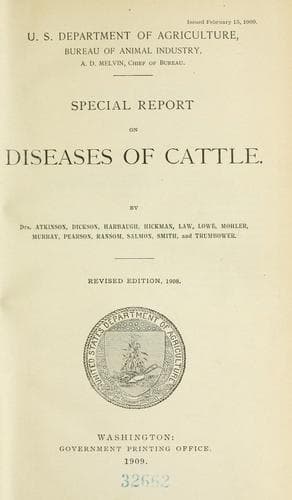
Special report on diseases of cattleUnited States. Bureau of Animal Industry
Science
Special report on diseases of cattle
United States. Bureau of Animal Industry
Cattle -- Diseases
In some cases the dissection of the calf is the only feasible means of
delivering it through the natural passages; and while it is especially
applicable to the dead calf, it is also on occasion called for in the case
of the living. As a rule, the living calf should be preserved, if possible,
but if this threatens to entail the death of the cow it is only in the case
of offspring of rare value that its preservation is to be preferred. To
those acquainted with the toil, fatigue, and discomfort of embryotomy, no
discussion is necessary so long as there is a prospect of success from the
simple and generally easier method of rectifying the faulty position of the
calf. When the correction of the position is manifestly impossible,
however, when distortions and monstrosities of the fetus successfully
obstruct delivery, when the pelvic passages are seriously contracted by
fractures and bony growths, when the passages are virtually almost closed
by swelling, or when the calf is dead and excessively swollen, no other
resort may be available. In many cases of distortion and displacement the
dismemberment of the entire calf is unnecessary, the removal of the
offending member being all that is required. It will be convenient,
therefore, to describe the various suboperations one by one and in the
order in which they are usually demanded.
_Amputation of the fore limb._--In cutting off a fore limb it is the one
presenting that should be selected, since it is much more easily operated
on, and its complete removal from the side of the chest affords so much
more space for manipulation that it often makes it easy to bring the other
missing limb or the head into position. The first consideration is to skin
the limb from the fetlock up and leave the skin attached to the body. The
reasons for this are: (_a_) That the skin is the most resistant structure
of the limb, and when it has been removed the entire limb can be easily
detached; (_b_) the tough skin left from the amputated limb may be used as
a cord in subsequent traction on the body of the calf; (_c_) the dissection
and separation of the limb are far more safely accomplished under the
protection of the enveloping skin than if the operator's hands and
instruments were in direct contact with the walls of the passages or womb;
(_d_) the dissection can be much more easily effected while the skin is
stretched by the left hand, so as to form a comparatively firmer resistant
point for the knife, than when it is attempted to cut the soft, yielding,
and elastic tissues which naturally offer little solid resistance, but
constantly recede before the cutting edge of the instrument. The
preservation of the skin is therefore a cardinal principle in the
amputation of all parts in which it is at all feasible.
Public-domain text, read in full here on John Shaqi.
Reviews
Reviews
No reviews yet
Be the first to share your thoughts on this work.
Elsewhere in the archive
Join the Discussion
Join the discussion
Sign in to leave a comment or review.
Sign InorCreate an account