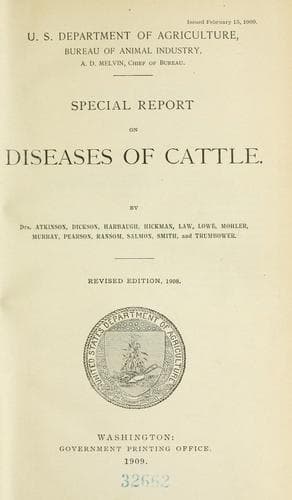
Special report on diseases of cattleUnited States. Bureau of Animal Industry
Science
Special report on diseases of cattle
United States. Bureau of Animal Industry
Cattle -- Diseases
_Formerly Professor of Veterinary Science, etc., in Cornell University._
FLOODING (BLEEDING FROM THE WOMB).
Though not so common in the cow as in the human female, flooding is
sufficiently frequent to demand attention. It may depend on a too rapid
calving and a consequent failure of the womb to contract when the calf has
been removed. The pregnant womb is extraordinarily rich in blood vessels,
especially in large and tortuous veins, which become compressed and almost
obliterated under contraction, but remain overfilled and often bleed into
the cavity of the womb should no contraction take place. Cox records cases
in which the labor pains had detached and expelled the fetal membranes,
while the calf, owing to large size or wrong presentation, was detained in
the womb, and the continued dilatation of the womb in the absence of the
fetal membranes led to a flow of blood which accumulated in clots around
the calf. Other causes are laceration of the cotyledons of the womb, or
from an antecedent inflammation of the placenta, and the unnatural adhesion
of the membranes to the womb, which bleeds when the two are torn apart.
Weakness of the womb from overdistention, as in dropsy, twins, etc., is not
without its influence. Finally, eversion of the womb (casting the withers)
is an occasional cause of flooding. The trouble is only too evident when
the blood flows from the external passages in drops or in a fine stream.
When it is retained in the cavity of the womb, however, it may remain
unsuspected until it has rendered the animal almost bloodless. The symptoms
in such case are paleness of the eyes, nose, mouth, and of the lips of the
vulva, a weak, rapid pulse, violent and perhaps loud beating of the heart
(palpitations), sunken, staring eyes, coldness of the skin, ears, horns,
and limbs, perspiration, weakness in standing, staggering gait, and,
finally, inability to rise, and death in convulsions. If these symptoms are
seen, the oiled hand should be introduced into the womb, which will be
found open and flaccid and containing large blood clots.
Public-domain text, read in full here on John Shaqi.
Reviews
Reviews
No reviews yet
Be the first to share your thoughts on this work.
Elsewhere in the archive
Join the Discussion
Join the discussion
Sign in to leave a comment or review.
Sign InorCreate an account