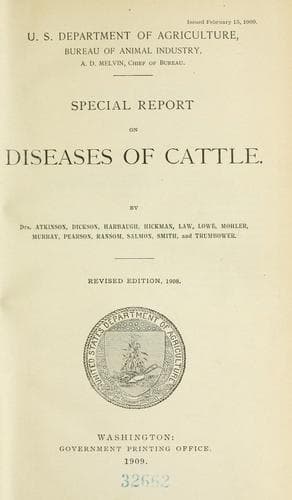
Special report on diseases of cattleUnited States. Bureau of Animal Industry
Science
Special report on diseases of cattle
United States. Bureau of Animal Industry
Cattle -- Diseases
from side to side to insure that the two horns of the womb are fully
extended and on about the same level before withdrawing the arm and
applying a truss.
When the womb has been long everted and is gorged with blood, inflamed, and
friable there is often the additional disadvantage that the animal is
unable or unwilling to rise. When lying down the straining can not be
controlled so effectually, and, even in the absence of straining, the
compression of the belly is so great as to prove a serious obstacle to
reduction. The straining may be checked by 2 or 3 ounces of laudanum or 2
ounces of chloral hydrate, or by inhalation of chloroform to insensibility,
and then by raising the hind parts on straw bundles the gravitation of the
abdominal organs forward may be made to lessen the resistance. If not
successful in this way, the cow may be further turned on her back, and if
return is still impossible, the hind limbs may be tied together and drawn
up to a beam overhead by the aid of a pulley. In this position, in place of
the pressure backward of the bowels proving a hindrance, their gravitation
forward proves a most material help to reduction. In seeking to return the
womb the sponging with ice-cold water, raising on a sheet, and wrapping in
a tight bandage should be resorted to. Another method which is especially
commendable in these inflamed conditions of the womb is to bring a piece of
linen sheet, 30 by 36 inches, under the womb, with its anterior border
close up to the vulva, then turn the posterior border upward and forward
over the organ, and cross the two ends over this and over each other above.
The ends of the sheet are steadily drawn, so as to tighten its hold on the
womb, which is thus held on the level of the vulva or above, and cold water
is constantly poured upon the mass. The reduction is further sought by
compression of the mass with the palms applied outside the sheet. Fifteen
or twenty minutes are usually sufficient to cause the return of the womb,
provided straining is prevented by pinching the back, or otherwise.
In old and aggravated cases, with the womb torn, bruised, or even
gangrenous, the only resort is to amputate the entire mass. This is done by
tying a strong, waxed cord around the protruding mass close to the vulva,
winding the cord around pieces of wood, so as to draw it as tightly as
possible, cutting off the organ below this ligature, tying a thread on any
artery that may still bleed, and returning the stump well into the vagina.
Public-domain text, read in full here on John Shaqi.
Reviews
Reviews
No reviews yet
Be the first to share your thoughts on this work.
Elsewhere in the archive
Join the Discussion
Join the discussion
Sign in to leave a comment or review.
Sign InorCreate an account