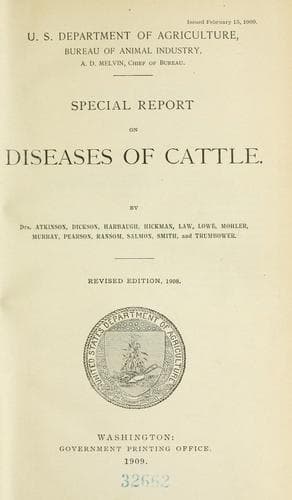
Special report on diseases of cattleUnited States. Bureau of Animal Industry
Science
Special report on diseases of cattle
United States. Bureau of Animal Industry
Cattle -- Diseases
_Treatment._--Treatment with the injections advised for vaginitis is
successful in mild or recent cases. In obstinate ones stronger solutions
may be used after the womb has been washed out by a stream of tepid water
until it comes clear. A rubber tube is inserted into the womb, a funnel
placed in its raised end, and the water, and afterwards the solution,
poured slowly through it. If the neck of the womb is so close that the
liquid can not escape, a second tube may be inserted to drain it off. As
injections may be used chlorid of zinc, one-half dram to the quart of
water, or sulphate of iron, 1 dram to the quart. Three drams of sulphate of
iron and one-half ounce ground ginger may also be given in the feed daily.
INFLAMMATION OF THE WOMB (METRITIS, INFLAMMATION OF WOMB AND ABDOMEN, OR
METROPERITONITIS).
Inflammation of the womb may be slight or violent, simple or associated
with putrefaction of its liquid contents and general poisoning, or it may
extend so that the inflammation affects the lining membrane of the whole
abdominal cavity. In the last two cases the malady is a very grave one.
_Causes._--The causes are largely the same as those causing inflammation of
the vagina. Greater importance must, however, be attached to exposure to
cold and wet and to septic infection.
_Symptoms._--The symptoms appear two or three days after calving, when the
cow may be seen to shiver, or the hair stands erect, especially along the
spine, and the horns, ears, and limbs are cold. The temperature in the
rectum is elevated by one or two degrees, the pulse is small, hard, and
rapid (70 to 100), appetite is lost, rumination ceases, and the milk
shrinks in quantity or is entirely arrested, and the breathing is hurried.
The hind limbs may shift uneasily, the tail be twisted, the head and eyes
turn to the right flank, and the teeth are ground. With the flush of heat
to the horns and other extremities, there is redness of the eyes, nose, and
mouth, and usually a dark redness about the vulva. Pressure on the right
flank gives manifest pain, causing moaning or grunting, and the hind limbs
are moved stiffly, extremely so if the general lining of the abdomen is
involved. In severe cases the cow lies down and can not be made to rise.
There is usually marked thirst, the bowels are costive, and dung is passed
with pain and effort. The hand inserted into the vagina perceives the
increased heat, and when the neck of the womb is touched the cow winces.
Examination through the rectum detects enlargement and tenderness of the
womb. The discharge from the vulva is at first watery, but becomes thick,
yellow, and finally red or brown, with a heavy or fetid odor. Some cases
recover speedily and may be almost well in two days; a large proportion
perish within two days of the attack, and some merge into the chronic form,
terminating in leucorrhea. In the worst cases there is local septic
infection and ulceration, or even gangrene of the parts, or there is
Public-domain text, read in full here on John Shaqi.
Reviews
Reviews
No reviews yet
Be the first to share your thoughts on this work.
Elsewhere in the archive
Join the Discussion
Join the discussion
Sign in to leave a comment or review.
Sign InorCreate an account