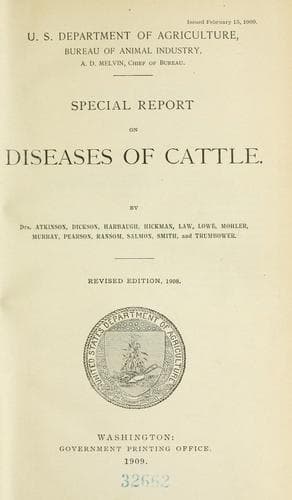
Special report on diseases of cattleUnited States. Bureau of Animal Industry
Science
Special report on diseases of cattle
United States. Bureau of Animal Industry
Cattle -- Diseases
This disease is not only peculiar to the cow, but it may be said to be
virtually confined to the improved and plethoric cow. It further occurs
only at or near the time of calving. Indeed, these two factors, calving and
plethora, may be set apart as preeminently the causes of this disease. It
is the disease of cows that have been improved in the direction of early
maturity, power of rapid fattening, or a heavy yield of milk, and hence it
is characteristic of those having great appetites and extraordinary power
of digestion. The heavy milking breeds are especially its victims, as in
them the demand for the daily yield of 50 to 100 pounds of milk means even
more than a daily increase of 2 to 3 pounds of body weight, mainly fat. The
victims are not always fat when attacked, but they are cows having enormous
powers of digestion, and which have been fed heavily at the time. Hence the
stall-fed, city-dairy cow, and the farm cow on a rich clover pasture in
June or July are especially subject. The condition of the blood globules in
the suffering cow attests the extreme richness and density of the blood,
yet this peculiarity appears to have entirely escaped the notice of
veterinary writers. I have never examined the blood of a victim of this
disease without finding the red-blood globules reduced to little more than
one-half their usual size. Now, these globules expand or contract according
to the density of the liquid in which they float. If we dilute the blood
with water they will expand until they burst, whereas if solids, such as
salt or albumin, are added they shrink to a large extent. Their small size,
therefore, in parturition fever indicates the extreme richness of the
blood, or, in other words, plethora.
Confinement in the stall is an accessory cause, partly because stabled
cattle are highly fed, partly because the air is hotter and fouler, and
partly because there is no expenditure by exercise of the rich products of
digestion.
High temperature is conducive to the malady, though the extreme colds of
winter are no protection against it. Heat, however, conduces to fever, and
fever means lessened secretion, which means a plethoric state of the
circulation. The heats of summer are, however, often only a coincidence of
the real cause, the mature rich pastures, and especially the clover ones,
being the greater.
Electrical disturbances have an influence of a similar kind, disturbing the
functions of the body and favoring sudden variations in the circulation. A
succession of cases of the malady often accompany or precede a change of
weather from dry to wet, from a low to a high barometric pressure.
Costiveness, which is the usual concomitant of fever, may in a case of this
kind become an accessory cause, the retention in the blood of what should
have passed off by the bowels tending to increase the fullness of the blood
vessels and the density of the blood.
Public-domain text, read in full here on John Shaqi.
Reviews
Reviews
No reviews yet
Be the first to share your thoughts on this work.
Elsewhere in the archive
Join the Discussion
Join the discussion
Sign in to leave a comment or review.
Sign InorCreate an account