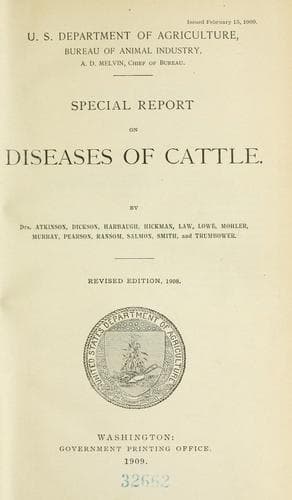
Special report on diseases of cattleUnited States. Bureau of Animal Industry
Science
Special report on diseases of cattle
United States. Bureau of Animal Industry
Cattle -- Diseases
The latest developments of treatment indicate very clearly that the main
cause is the production of poisonous, metabolic products (leucomains and
toxins) by secreting cells of the follicles of the udder, acting on the
susceptible nerve centers of the plethoric, calving cow. Less fatal
examples of udder poisons are found in the first milk (colostrum), which is
distinctly irritant and purgative, and in the toxic qualities of the first
milk drawn from an animal which has been subjected to violent overexertion
or excitement. Still more conclusive as to the production of such poisons
is the fact that the full distention of the milk ducts and follicles, and
the consequent driving of the blood out of the udder and arrest of the
formation of depraved products, determines a speedy and complete recovery
from the disease. This does not exclude the other causes above named, nor
the influence of a reflex nervous derangement proceeding from the udder to
the brain.
_Symptoms._--It may be said that there are two extreme types of this
disease, with intervening grades. In both forms there is the characteristic
plethora and more or less sudden loss of voluntary movement and sensation,
indicating a sudden collapse of nervous power; in one, however, there is
such prominent evidence of congestion of head and brain that it may be
called the congestive form par excellence, without thereby intimating that
the torpid form is independent of congestion.
In the congestive form there is sudden dullness, languor, hanging back in
the stall, or drooping the head, uneasy movements of the hind limbs or
tail; if the cow is moved, she steps unsteadily, or even staggers; she no
longer notices her calf or her feed; the eyes appear red and their pupils
dilated; the weakness increases and the cow lies down or falls and after
that is unable to rise. At this time the pulse is usually full, bounding,
and the temperature raised, though not invariably so, the head, horns, and
ears being especially hot and the veins of the head full, while the visible
mucous membranes of nose and eyes are deeply congested.
Public-domain text, read in full here on John Shaqi.
Reviews
Reviews
No reviews yet
Be the first to share your thoughts on this work.
Elsewhere in the archive
Join the Discussion
Join the discussion
Sign in to leave a comment or review.
Sign InorCreate an account