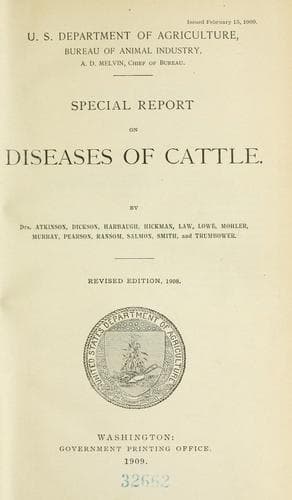
Special report on diseases of cattleUnited States. Bureau of Animal Industry
Science
Special report on diseases of cattle
United States. Bureau of Animal Industry
Cattle -- Diseases
In the torpid form of the disease there is much less indication of fever or
violence. There may be no special heat about the horns, ears, or forehead,
nor any marked redness or congestion of the eyes or nose, nor engorgement
of the veins of the head. The attack comes on more slowly, with apparent
weakness of the hind limbs, dullness, drowsiness, suspension of rumination
and appetite, and a general indifference to surrounding objects. Soon the
cow lies down, or falls and is unable to rise, but for one or two days she
may rest on the breastbone and hold the head in the flank without showing
any disorderly movements. Meanwhile there is not only loss of muscular
power and inability to stand, but also considerable dullness of sensation,
pricking the skin producing no quick response, and even touching the edge
of the eyelids causing no very prompt winking. Unless she gets relief,
however, the case develops all the advanced symptoms of the more violent
form, and the animal perishes.
In advanced and fatal cases of either form the insensibility becomes
complete; no irritation of skin or eye meets any response; the eye becomes
more dull and glassy; the head rests on the ground or other object; unless
prevented the cow lies stretched fully on her side; the pulse is small,
rapid, and finally imperceptible; the breathing is slow, deep, stertorous,
and the expirations accompanied with puffing is slow, the cheeks, and death
comes quietly or with accompanying struggles.
_Prevention._--For such fatal disease prevention is of far more consequence
than treatment. Among the most efficient preventives may be named a spare
diet (amounting to actual starvation in very plethoric, heavy-milking cows)
for a week before calving and at least four days after. A free access to
salt and water is most important, as the salt favors drinking and the water
serves to dilute the rich and dense blood. Iced water, however, is
undesirable, as a chill may favor the onset of fever. A dose of Epsom salt
(1 to 2 pounds) should be given 12 to 24 hours before calving is due, so
that it may operate at or just before that act. In case calving has
occurred unexpectedly in the heavy milker, no time should be lost in giving
the purgative thereafter. A most important precaution in the fleshy,
plethoric cow, or in one that has been attacked at a previous calving, is
to avoid drawing any milk from the bag for 12 or 24 hours after calving.
Breeders on the island of Jersey have found that this alone has almost
abolished the mortality from milk fever. If Epsom salt is not at hand,
saltpeter (1 ounce) should be used for several days. Daily exercise is also
of importance, and, excepting in midsummer, when the heat of the sun may be
injurious, the value of open air is unquestionable. Even in summer an open
shed or shady grove is incomparably better than a close, stuffy stall. A
rich pasture (clover especially), in May, June, or July, when at its best,
is to be carefully avoided.
Public-domain text, read in full here on John Shaqi.
Reviews
Reviews
No reviews yet
Be the first to share your thoughts on this work.
Elsewhere in the archive
Join the Discussion
Join the discussion
Sign in to leave a comment or review.
Sign InorCreate an account