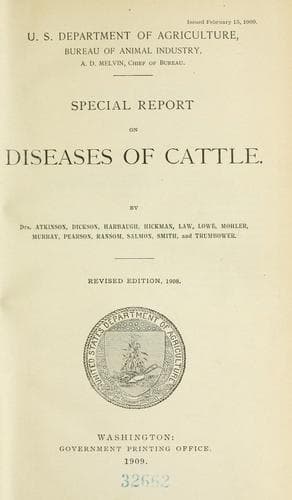
Special report on diseases of cattleUnited States. Bureau of Animal Industry
Science
Special report on diseases of cattle
United States. Bureau of Animal Industry
Cattle -- Diseases
In heavy milkers, before and just after calving, it is the rule that the
mammary gland is enlarged, hot, tense, and tender, and that a slight
exudation or pasty swelling extends forward from the gland on the lower
surface of the abdomen. This physiological congestion is looked upon as a
matter of course, and disappears in two or three days when the secretion of
milk has been fully established. This breaking up of the bag may be greatly
hastened by the sucking of a hungry calf and the kneading it gives the
udder with its nose, by stripping the glands clean thrice daily, and by
active rubbing at each milking with the palm of the hand, with or without
lard or, better, with camphorated ointment.
The congestion may be at times aggravated by standing in a draft of cold
air or by neglect to milk for an entire day or more (overstocking, hefting)
with the view of making a great show of udder for purposes of sale. In such
cases the surface of the bag pits on pressure, and the milk has a reddish
tinge or even streaks of blood, or it is partially or fully clotted and is
drawn with difficulty, mixed, it may be, with a yellowish serum (whey)
which has separated from the casein. This should be treated like the above,
though it may sometimes demand fomentations with warm water to ward off
inflammation, and it may be a week before the natural condition of the
gland is restored.
INFLAMMATION OF THE UDDER (SIMPLE MAMMITIS).
Congestion may merge into active inflammation, or it may arise direct, in
connection with exposure to cold or wet, with standing in a cold draft,
with blows on the udder with clubs, stones, horns, or feet, with injury
from a sharp or cold stone, or the projecting edge of a board or end of a
nail in the floor, with sudden and extreme changes of weather, with
overfeeding on rich albuminous feed like cotton seed, beans, or peas, with
indigestions, with sores on the teats, or with insufficient stripping of
the udder in milking. In the period of full milk the organ is so
susceptible that any serious disturbance of the general health is liable to
fall upon the udder.
_Symptoms._--The symptoms and mode of onset vary in different cases. When
following exposure there is usually a violent shivering fit, with cold
horns, ears, tail, and limbs, and general erection of the hair. This is
succeeded by a flush of heat (reaction) in which the horns, ears, and limbs
become unnaturally warm and the gland swells up and becomes firm and solid
in one, two, three, or all four quarters. There is hot dry muzzle, elevated
temperature, full, accelerated pulse, and excited breathing, impaired or
suspended appetite and rumination, with more or less costiveness,
suppression of urine, and a lessened yield of milk, which may be entirely
suppressed in the affected quarter.
Public-domain text, read in full here on John Shaqi.
Reviews
Reviews
No reviews yet
Be the first to share your thoughts on this work.
Elsewhere in the archive
Join the Discussion
Join the discussion
Sign in to leave a comment or review.
Sign InorCreate an account