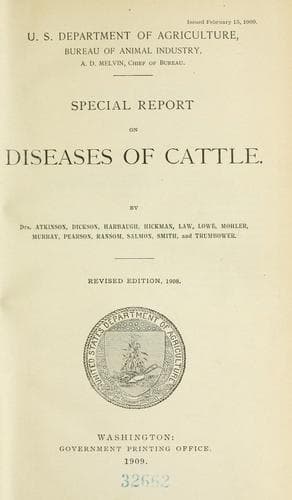
Special report on diseases of cattleUnited States. Bureau of Animal Industry
Science
Special report on diseases of cattle
United States. Bureau of Animal Industry
Cattle -- Diseases
Another form almost universally prevalent in this district of central New
York in 1889 broke out on the teats and udders as blisters strongly
resembling cowpox, but which were not propagated when inoculated on calves.
It was only exceptionally that this extended through the teat to the gland
tissue, yet in some instances the bag was lost from this cause. Scarlatina
in man was very prevalent at the time (many schools were closed in
consequence), but no definite connection seemed to exist between this and
the cow disease, and on different dairy farms there were families of young
children that had never had scarlet fever and who did not at that time
contract it.
The most common cause of contagious mammitis in cattle is a spherical
bacterium in chain form (_Streptococcus_) (Moore, Ward). Yet it is clear
that contagious mammitis is not a single affection, but a group of diseases
which have this in common, that they attack the udder.
_Prevention._--Prevention is to be especially sought in all such cases. In
purchasing new cows see that they come from a herd where the teats and
udder are sound. If a new cow with unknown antecedents comes from a public
market, let her be milked for a week by a person who does not milk any
other cows. Keep her in a separate stall from others, so that there may be
no infection from litter or flooring. Wash the udder with soap and water,
and wet with a solution of two teaspoonfuls of carbolic acid in a pint of
water before letting the regular milker of the other cows take her. If any
cow in the herd shows the indurated end of the teat or the inflammation and
nodular tender character of the gland, sequestrate her at once and give her
a separate milker. If another cow is to be put into the stall she occupied,
first clean and scrape it, and wet it with a strong solution of bluestone,
5 ounces in a gallon of water. The milk may be drawn off with a teat tube,
or spring teat dilator (Pl. XXIV, figs. 3 and 4), and the milk ducts
injected frequently with a solution of peroxid of hydrogen or iodoform. I
have had little success in checking the upward progress of the disease
through the teat with carbolic acid or boric-acid solutions. Used on the
outside of the other teats, however, they may serve to prevent them from
becoming infected. In the absence of peroxid of hydrogen the affected teat
may be injected with a solution of 1 grain corrosive sublimate in a pint of
water, and the same may be used on the other teats, provided it is washed
off every time before milking.
Public-domain text, read in full here on John Shaqi.
Reviews
Reviews
No reviews yet
Be the first to share your thoughts on this work.
Elsewhere in the archive
Join the Discussion
Join the discussion
Sign in to leave a comment or review.
Sign InorCreate an account