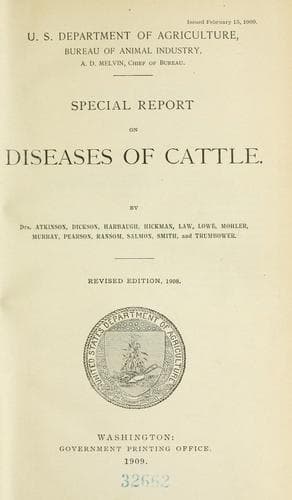
Special report on diseases of cattleUnited States. Bureau of Animal Industry
Science
Special report on diseases of cattle
United States. Bureau of Animal Industry
Cattle -- Diseases
The disease in the cow is ushered in by a slight fever, which, however, is
usually overlooked, and the first sign is tenderness of the teats.
Examined, these may be redder and hotter than normal, and at the end of two
days there appear little nodules, like small peas, of a pale-red color, and
increasing so that by the seventh day they may measure three-fourths of an
inch to 1 inch in diameter. The yield of milk diminishes, and when heated
it coagulates slightly. From the seventh to the tenth day the eruption
forms into a blister, with raised margins and a depression in the center,
and from which the whole of the liquid can not be drawn by a single
puncture. The blister, in other words, is chambered, and each chamber must
be opened to evacuate the whole of the contents. If the pock forms on a
surface where there is thick hair it does not rise as a blister, but oozes
out a straw-colored fluid which concretes on the hairs in an amber-colored
mass. In one or two days after the pock is full it becomes yellow from
contained pus and then dries into a brownish-yellow scab, which finally
falls, leaving one or more distinct pits in the skin. Upon the teats,
however, this regular course is rarely seen; the vesicles are burst by the
hands of the milker as soon as liquid is formed, and as they continue to
suffer at each milking they form raw, angry sores, scabbing more or less at
intervals, but are slow to undergo healing.
The only treatment required is to heal the sores. As milking is the main
cause of their persistence, that must be done as gently as possible, or
even with the teat tube or dilator. (Pl. XXIV, figs. 3 and 4.) It is
essential to check the propagation of the germ, and for this purpose the
sore teats may be washed frequently with a solution of half an ounce
hyposulphite of soda in a pint of water. This will usually check the
inflammation and cut short the malady.
SUPPRESSION OF MILK.
The absence of milk in the udder may result from ill health, debility,
emaciation, chronic disease of the bag, wasting of the gland from previous
disease, or insufficient feed, but sometimes it will occur suddenly without
any appreciable cause. The treatment consists in removing the cause of the
disease, giving rich albuminoid feed made into warm mashes, and
administering ounce doses of aromatic carminatives, like anise seed, fennel
seed, etc. Rubbing and stripping the udder are useful; the application of
oil of lavender or of turpentine, or even a blister of Spanish flies, will
sometimes succeed.
BLOODY MILK.
Public-domain text, read in full here on John Shaqi.
Reviews
Reviews
No reviews yet
Be the first to share your thoughts on this work.
Elsewhere in the archive
Join the Discussion
Join the discussion
Sign in to leave a comment or review.
Sign InorCreate an account