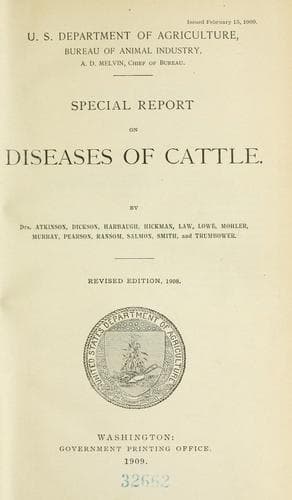
Special report on diseases of cattleUnited States. Bureau of Animal Industry
Science
Special report on diseases of cattle
United States. Bureau of Animal Industry
Cattle -- Diseases
The most violent and deadly form of diarrhea in the newborn calf deserves a
special mention. This may appear immediately after birth, and shows itself
almost invariably within the first or second day. The most intense symptoms
of white scour are complicated by great dullness, weakness, and
prostration, sunken eyes, retracted belly, short, hurried breathing, and
very low temperature, the calf lying on its side, with the head resting on
the ground, lethargic and unconscious or regardless of all around it. The
bowel discharges are profuse, yellowish white, and very offensive. As a
rule death ensues within 24 to 36 hours.
A marked characteristic of this form of illness is that it attacks almost
every calf born in the herd, or in the building, rather, and if the calf
escapes an attack in the first two or three days of its life it usually
survives. Those that recover from an attack, however, are liable one or two
weeks later to suffer from an infective inflammation of the lungs. The
infection clings to a stable for years, in many cases rendering it
impossible to preserve and raise the calves. It has frequently coincided
with abortions and failures to conceive in the same herd, so that it has
been thought that the same infective germ produces one type of abortion. On
the other hand, the removal of the calving cow from the herd to calve in a
separate building, hitherto unused and therefore uninfected, usually
effects the escape and survival of the offspring.
The disease has been traced by Nocard and LigniËres to a small bacillus
having the general characters of those that produce hemorrhagic septicemia,
which is usually combined with a variety of others, but is in some cases
alone and in pure culture, especially in the joints. The theory of
LigniËres is that this bacillus is the primary offender, and that once
introduced it so depresses the vital powers of the system and tissue cells
that the healthy resistance to other bacteria is impaired or suspended, and
hence the general and deadly invasion of the latter.
Inoculations with this bacillus killed guinea pigs or rabbits in 6 to 18
hours, and calves in 30 hours, with symptoms and lesions of hemorrhagic
septicemia, including profuse fetid diarrhea.
The predominance of the early and deadly lesions in the alimentary tract
would seem to imply infection through the feed, and the promptitude of the
attack after birth, together with the frequent coincidence of contagious
abortion in the herd, suggest the presence of the germ in the cow; yet the
escape of the calf when the cow calves in a fresh building is equally
suggestive of the infection through germs laid up in the building. This
conclusion is further sustained by the observation that the bacillus
evidently enters by the raw, unhealed navel, that it is diffused in the
blood, and that a very careful preservation of the navel against infection
gives immunity from attack.
Public-domain text, read in full here on John Shaqi.
Reviews
Reviews
No reviews yet
Be the first to share your thoughts on this work.
Elsewhere in the archive
Join the Discussion
Join the discussion
Sign in to leave a comment or review.
Sign InorCreate an account