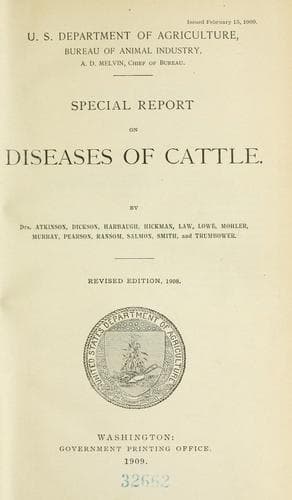
Special report on diseases of cattleUnited States. Bureau of Animal Industry
Science
Special report on diseases of cattle
United States. Bureau of Animal Industry
Cattle -- Diseases
Inflammation of the compact structure of bones (osteitis) may be either
acute or chronic, and may involve the whole extent of the bone affected or
may be confined to only a portion of it. This inflammation results from
injury, such as concussion, laceration, or a crushing bruise; also from
specific influences, as in actinomycosis (lumpy jaw) or cases of foul foot.
The latter affection frequently involves the bones, and for this reason the
pastern is the most frequent seat of osteitis. There is dull pain on
pressure and a painful swelling of bone when pus is present. Suppuration
may involve the overlying soft tissues, causing an abscess, which may
finally break through the skin. The inflammatory condition sometimes
assumes an ulcerated form (caries) or from interrupted nutrition of the
part deprived of the blood necessary to its nourishment may cause death of
a large section of bone (necrosis); this dead fragment (sequestrum),
becoming separated from the main portion of bone, acts as a foreign body.
_Treatment._--This consists in resting the affected part and in giving vent
at the earliest possible moment to whatever pus may be present. Free
drainage should then be maintained. Apply dressings of lactic acid or
inject with 5 per cent zinc-chlorid solution and pack with tampons of
cotton soaked in antiseptic solutions. A laxative to keep the bowels moving
freely is the only internal treatment necessary.
PERIOSTITIS.
This disease is an inflammation of the external covering of bone
(periosteum) and is usually produced by wounds, pressure, or crushing the
part. The periosteum is well supplied with sensitive nerve endings and when
inflamed is very sensitive to pressure and may cause lameness. This
condition is often difficult to determine, and even an acute observer may
fail to locate the point of its existence. There are three forms of
periostitis--aseptic, purulent, and fibrous.
ASEPTIC PERIOSTITIS when it becomes chronic causes such a bony enlargement
(exostosis) as is seen in the callous formation following the fracture of a
bone. The formation of such a tumor or enlargement on the surface of a bone
is liable to occur in any part of the bone covered with periosteum, and
when found near a joint involving two or more bones it is liable to result
in their union (anchylosis).
_Treatment._--Applications of cold water to check the inflammatory
processes is indicated for the first few days in aseptic periostitis,
followed by hot fomentations to hurry resorption of fluids. Massage should
then be given with camphor ointment, mercurial ointment, soap liniment, or
Lugol's solution. In the chronic form point firing or a biniodid-of-mercury
blister will be found beneficial.
Public-domain text, read in full here on John Shaqi.
Reviews
Reviews
No reviews yet
Be the first to share your thoughts on this work.
Elsewhere in the archive
Join the Discussion
Join the discussion
Sign in to leave a comment or review.
Sign InorCreate an account