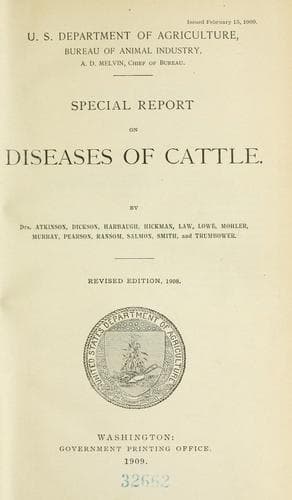
Special report on diseases of cattleUnited States. Bureau of Animal Industry
Science
Special report on diseases of cattle
United States. Bureau of Animal Industry
Cattle -- Diseases
Another and perhaps the simplest of all methods is the application of a
plaster-of-Paris bandage, which is made as follows: Strips of thin
cheesecloth 3 inches wide and 8 or 9 feet long are laid flat on a board and
on them is spread a layer of plaster of Paris about one-eighth of an inch
thick; then, starting at one end, roll carefully so as to gather the
plaster in between the layers of the bandage. It is of course important
that the cloth be thin and the plaster of Paris fresh and active. After
preparing four or five of such bandages the operator is ready to dress the
fracture, which, after the parts have been brought into position, should be
done by covering all that part of the limb to which the plaster-of-Paris
bandage is to be applied with a single layer of the dry bandage, letting it
extend both above and below the part to which the plaster bandage is to be
applied and including under the folds of the dry bandage at each end a
layer of absorbent cotton, which is intended to form a pad to prevent the
ends of the plaster bandage from chafing the skin beneath. When this is
done one of the plaster bandages should be placed in a vessel of water and
allowed to remain till the air bubbles have ceased to rise from it, which
will generally indicate that it is soaked through. Then, taking it in the
hand, wind it carefully around and around the limb, unrolling the bandage
as it is wound around the limb, occasionally smoothing down the plaster of
Paris. Should it form roughly or in ridges the hand may be dipped in water
to impart increased moisture to it. When about finished with one bandage,
place another one in the water, so that the winding operation may be
continued without delay. The bandages should be applied till the cast is
from one-half to three-quarters of an inch thick, then gently restrain the
animal for one-half or three-quarters of an hour till the plaster is
hardened. Any of the appliances used should be so manipulated as to prevent
absolutely any motion of the detached parts. If the fracture is near a
joint, it is generally best to include the joint in the appliance. The part
of the limb below the bandage should be carefully and firmly wrapped with
an ordinary cotton bandage all the way from the plaster bandage down to the
hoof. This last bandage will tend to prevent swelling, which is liable to
occur, the result of the dependent position in which the animal is forced
by nature to keep the injured limb.
Public-domain text, read in full here on John Shaqi.
Reviews
Reviews
No reviews yet
Be the first to share your thoughts on this work.
Elsewhere in the archive